
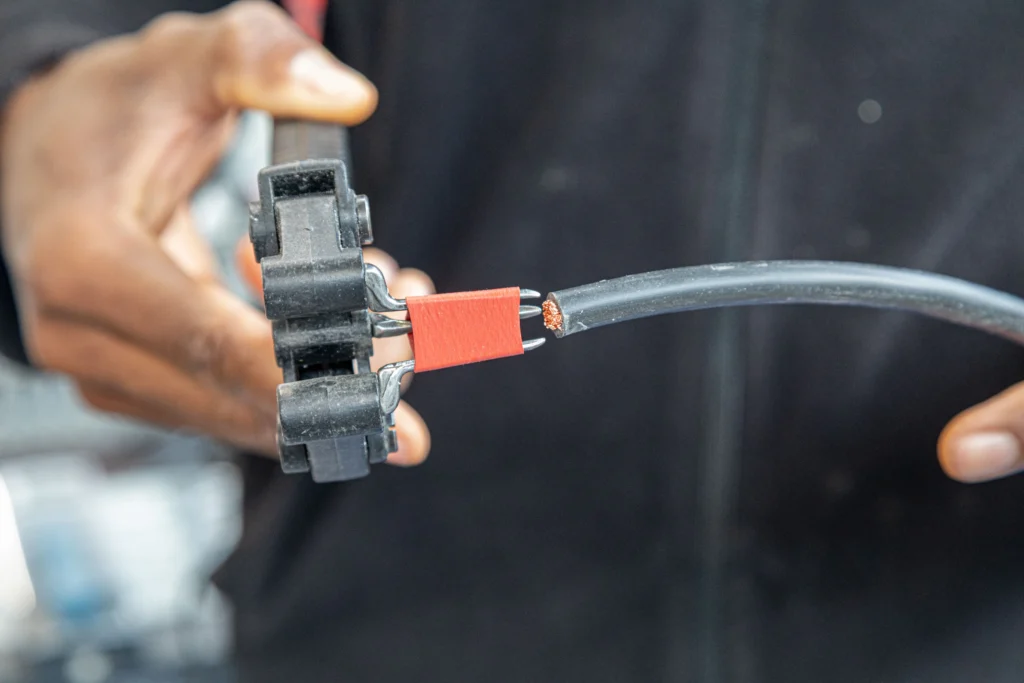
Automotive electrical wire connectors and terminals are the basic framework of each vehicle ‘s electrical architecture. Whether you are troubleshooting the occasional flashing fault of the dashboard indicator, rebuilding a damaged wiring harness, or designing the electrical system of a custom off-road vehicle from scratch, it is an indispensable core skill to fully master the knowledge of automotive and electrical wiring harness connectors and terminals.
What Are Automotive and Electrical Wire Connectors and Terminals?
Automotive and electrical wire connectors and terminals are electromechanical devices that reliably connect two or more electrical conductors to form a low-resistance stabilization loop. A modern car can lay several kilometers of wires inside and is equipped with hundreds of independent automotive connectors, each performing specific functions under harsh conditions such as high temperature, vibration, humidity and chemical corrosion.

Automotive connector: an insulating shell made of thermoplastic polymer. The common material is nylon PA66 or Polybutylene Terephthalate, which is used to fix and lock multiple terminals and form a Keyed Mating Interface with the contralateral connector.
Learn more about automotive connector types: Guide To Automotive Connector Types And Performance Analysis
Terminal: the metal contact of crimped or soldered at the end of a single wire. The material is usually brass or tin-plated copper alloy.
The two together form a complete mating pair and need to maintain stable conductivity throughout the vehicle’s life cycle.
Understanding the difference between the two is crucial: when the circuit fails, the problem usually occurs on the terminal side (corrosion, virtual pressure/cold crimp, broken strand) or the connector shell side (lock failure, seal aging). Identifying which one to check first can save a lot of diagnostic time.
Why Do You Need Car Seal and Closure Mechanisms?
The sealing system is the most important part of an automotive wiring harness. The role of car seal and closure mechanisms is to prevent moisture, oils, road salts and other pollutants from entering the connector interface and preventing terminal corrosion.

Why car seal and closure mechanisms can not be ignored?
Even if there is only one corroded terminal, it will produce milli-ou resistance, which will lead to sensor signal error, ECU (engine control unit) fault code, intermittent misfire, and even complete circuit disconnection. The modern CAN bus (controller area network) and LIN network (local interconnection network) are particularly sensitive to such resistance variations and signal interference. A tainted automotive connector may trigger dozens of difficult-to-diagnose intermittent fault codes in the vehicle controller network.
Seal and closure mechanisms are not optional but necessary in any application that may be exposed to wet or polluted environments, such as the engine compartment, under the chassis, and external lighting areas of the body. They directly determine whether the repaired parts can work stably for up to 10 years or fail again after the next rain.
Learn more about the benefits of sealed connectors
How does the single wire seal work?
In the sealing system of the automotive connector, the protection of a single wire is also indispensable in addition to the shell sealing. Single wire seal is a kind of tiny silicone gasket with rib structure, which is pre-set on the wire before the terminal crimping and inserted into the connector cavity with the terminal.
When the wire enters the connector cavity, the flexible ribs on the sealing ring will be tightly squeezed on the inner wall of the plastic shell to form a reliable waterproof barrier. Even if the water vapor is sputtered to the back of the wire harness, this sealing structure can prevent water from seeping into the metal contact point along the wire insulation layer. This is a necessary component for IP67 and IP68 waterproofing standards under stringent performance requirements.
Learn more: Single Wire Seal: Ultimate Guide For Superior Waterproof Connections
Automotive Connector IP Rating Reference
IP rating is a quantitative indicator of the automotive connector’s ability to resist solid particles and liquid intrusion according to the IEC 60529 standard.
| IP Rating | Protection Level | Suitable Environment |
|---|---|---|
| IP54 | Dust limited, splash resistant | Cabin interior, protected underhood |
| IP65 | Dust tight, low-pressure water jet | Exterior lighting, exposed body panels |
| IP67 | Dust tight, temporary immersion(1m/30min) | Underbody, wheel arch,engine bay |
| IP68 | Dust tight, continuous immersion | Submerged applications, EV battery packs |
| IP69K | High-pressure, high-temp wash | Agricultural, commercial vehicles |
IP67 is the recommended minimum protection standard for most engine compartment and chassis applications. The Deutsch DT series and AMP Superseal connectors can reach the IP67 protection level under the premise of correct installation (including wire seal ring specification matching and blind hole plug installation).
How to Choose the Right Automotive Connector and Terminal?
Step 1: Confirm the wire gauge
The applicable wire specifications are marked or color coded on the crimp barrel of each terminal. Pressing a 16 AWG wire into a terminal with a rated range of 22-18 AWG will produce a cold crimp with insufficient mechanical strength and lead to an increase in contact resistance. Selecting the terminal should be based on wire specifications, do not reverse matching.
Step 2: Check the current rating
The terminals are calibrated with continuous current. Overload will cause local heat accumulation at the terminal, damage the insulation layer, melt the shell, or cause terminal bluing and eventually failure. The rated current should be used at 80 % derate in a high vibration or high temperature environment.
Step 3: Determine the required sealing class
Refer to the above IP level table. Unsealed automotive connectors can be used for internal applications in the passenger compartment; the full sealing scheme with wire seal ring and blind hole plug should be selected for all application scenarios that may be exposed to moisture, water splash, condensation or high-pressure flushing.
Step 4: Comparison of OEM vs. aftermarket
| Factor | OEM/OES Automotive Connectors | Quality Aftermarket |
|---|---|---|
| Material spec | PA66-GF30 housing, EPDM seals | PA66 standard;seal material varies |
| Terminal plating | Selective gold or tin, tight tolerance | Tin standard; quality varies widely |
| Pin fit | Matched to mating half | May require adapters |
| Price | Higher | Lower |
| Availability | Dealer or specialist | Wide, including online |
| Bestuse | Safety-critical systems,airbags, ABS | Auxiliary circuits, lighting,accessories |
It is imperative to purchase OEM or OES automotive connectors for powertrains, safety systems (airbags/ABS/ESC) and emissions sensors. Deutsch, TE Connectivity, Molex, Tyco and other brands of high-quality after-sales products are fully applicable for accessories, lighting modification and auxiliary circuits.
Learn more: OEM Vs. Aftermarket Automotive Connectors: What’s The Best ChoiceFor Your Vehicle?
Recommended Tools for Professional Crimping:
- Ratcheting Crimper, Non-Bypass Type: Ensure that each crimping is complete and in place with high consistency. Knipex 97 51 180, IWISS SN-2549, TE Connectivity CERTI-CRIMP II are recognized as reliable options in the industry.
- Precision Wire Stripper: Match the gauge to prevent cutting the core (strand nicking).
- Terminal Pick Set: Remove the terminal in the shell without damaging the locking tang.

Deutsch/Superseal Seal Insertion Tool: Ensure that the wire seal is completely located in the cavity before inserting the terminal.
For more in-depth crimping technical specifications, please refer to the IPC/WHMA-A-620 Standard for Cable and Wire Harness Assemblies and SAE J163 Low Tension Wiring Connectors specification.
Conclusion
You can eliminate the most common fault in automotive electrical systems by using properly pressed crimping terminals, using high-quality wire terminals, and ensuring that a strong automotive seal and closure mechanism can protect the environment. Whether you are carrying out simple maintenance or designing complex wiring harnesses, following the scientific principles of connection is the key to success.
FAQ
If you’re looking for top-tier copper lugs and ring terminals, it’s less about one “best” brand and more about choosing manufacturers known for material quality, certifications, and consistency. Cheap connectors fail at the crimp—good ones don’t.
In the American Wire Gauge (AWG) system, 0 gauge and 1/0 gauge (pronounced “one-aught”) refer to the same size of terminal and wire. There is no physical or electrical difference between them; they are simply different ways of writing the same specification.
Choosing the right connectors for a car audio system is the difference between a high-fidelity experience and a frustrating weekend of troubleshooting blown fuses or static. In the United States, we primarily use the American Wire Gauge (AWG) standard, so ensure your connectors match the gauge of your wire exactly.
Modern vehicles are complex machines that rely on dozens of different seals to keep fluids in, contaminants out, and the cabin quiet. These seals are generally categorized by where they are located and what they are protecting.