
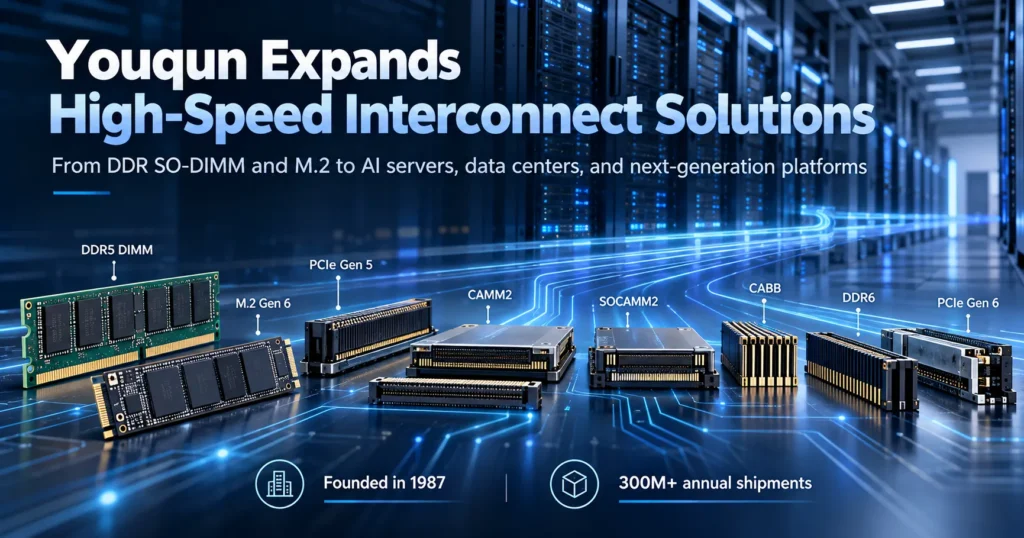
At this year’s Open Data Center Conference and the inaugural Computing Expo, Youqun Technology showcased a range of high-speed connectivity products, highlighting its technological footprint in AI servers, data centers, and next-generation high-speed interconnects.
Founded in 1987, this connector manufacturer has long specialized in memory and storage connectors. With its two core products – DDR SO-DIMM and M.2 – Youqun has established mature capabilities in high-speed connection design and large-scale manufacturing, achieving combined annual shipments exceeding 300 million units.
As AI servers evolve from single-compute architectures toward heterogeneous computing and diverse platform designs, Youqun is extending its years of accumulated expertise in connectivity and manufacturing into the server and data center markets.
From DDR5 DIMM and PCIe Gen 5 to new press-fit products such as CAMM2, SOCAMM2, and CABB, and forward-looking initiatives on DDR6, M.2 Gen 6, and PCIe Gen 6, Youqun is expanding its portfolio of high-speed interconnect solutions and actively engaging earlier in customers’ next-generation platform development.
01
AI Computing Power Competition
Is Extending Down to a Single Connector
The primary battlefield for AI computing power lies in chips, but whether that power can be fully fed often depends on what lies beyond the chip – memory bandwidth and the high-speed expansion channel.
As AI applications expand from large model training to inference and diverse use cases, server computing architectures continue to evolve. Beyond GPUs and other accelerators, configurations involving CPUs, memory, and high-speed expansion interfaces across different platforms are becoming increasingly diversified.
Youqun has observed in certain next-generation server platforms that the ratio of CPU to GPU configurations is approaching 1:1 to 1:2. Meanwhile, the growth of Arm architecture and customized computing platforms is driving more differentiated design requirements for memory capacity, module configurations, and high-speed expansion.
This shift creates new market opportunities for DDR DIMM and PCIe connectors.
In terms of memory, different computing architectures demand greater diversity in capacity, bandwidth, and scalability. Traditional DDR DIMMs remain critical memory interface components in servers, and Youqun continues to invest in DDR5 DIMM development to meet evolving memory design needs across various computing platforms.
For high-speed expansion, the advancement of GPUs, network adapters, and various accelerator cards ensures that PCIe remains a key component in server platform design.
PCIe Gen 5 achieves a transmission rate of 32 GT/s, while PCIe Gen 6 further doubles it to 64 GT/s. This continuous increase in interface speed imposes higher demands on connector signal integrity, structural design, and manufacturing consistency.
Youqun has already launched PCIe Gen 5 connectors supporting 32 GT/s and continues investing heavily in next-generation high-speed connectivity technologies.
The opportunities brought by AI servers extend far beyond simple upgrades in connector specifications – they encompass systemic demands across memory, storage, high-speed expansion, and internal interconnects.
This has become a key direction for Youqun’s ongoing expansion in server high-speed connectivity products.
Moreover, Youqun’s role in industry standards goes well beyond that of a supplier. In 2018, it was invited by JEDEC and Intel to co-develop DDR5 SO-DIMM and DDR5 DIMM connectors; by late 2023, JEDEC had released the CAMM2 universal standard. The SO-CAMM standard, extending the LPDDR5 CAMM2 form factor, directly brings compression-based connectivity to AI servers – SO-CAMM2 further extends this compression technology into AI server and high-performance computing applications, offering new options for system design in memory bandwidth, spatial configuration, and power efficiency.
02
From Plug-in to Compression-Based
High-Density Systems Need More Connection Options
For many years, traditional plug-in DIMMs have been a key module format for server memory. Mature and widely adopted, they meet capacity and scalability requirements across various computing platforms.
However, as AI servers evolve toward higher density, greater bandwidth, and diverse architectures, system design faces new challenges: how to balance memory configuration, signal transmission, thermal airflow, and maintenance within limited space?
While conventional DIMMs continue to evolve, compression-based modules such as CAMM2 and SO-CAMM2 offer fresh design alternatives for different system architectures.
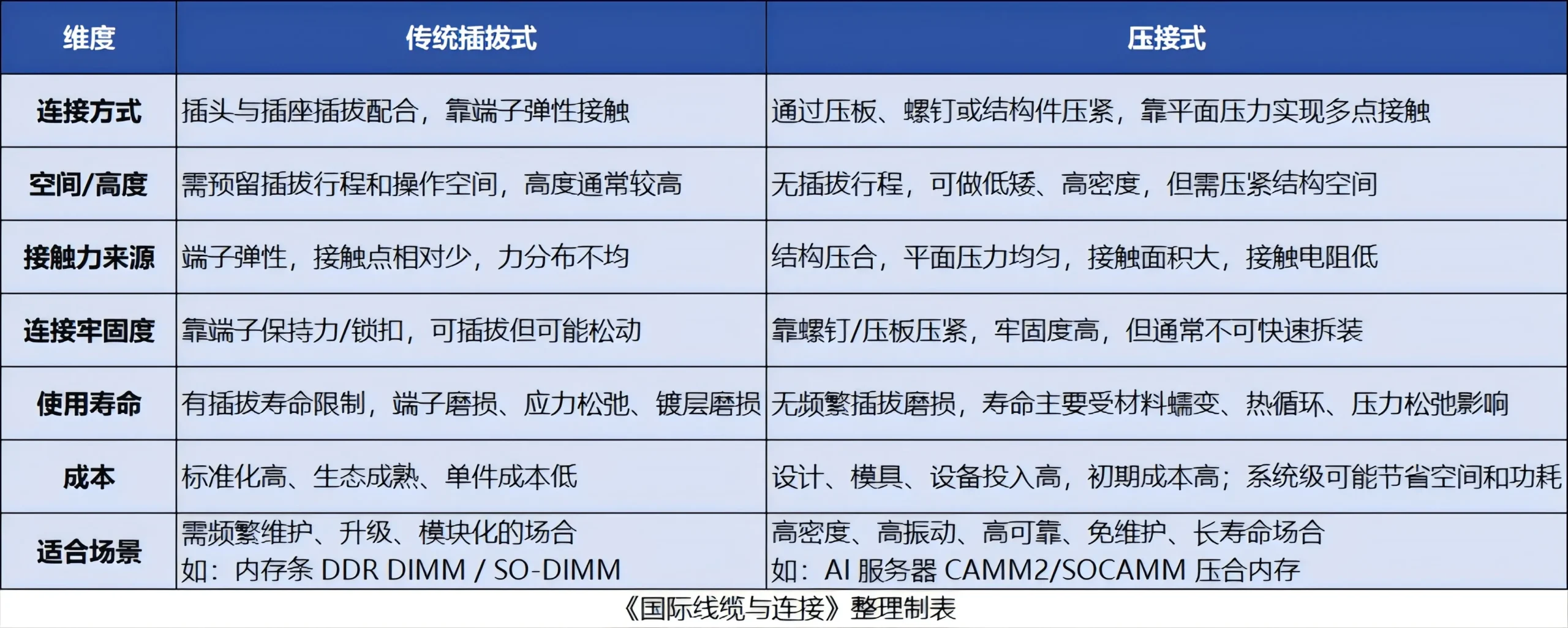
Unlike traditional horizontal insertion methods, compression-based connections use mechanical pressing mechanisms to generate the required contact force, ensuring reliable engagement between connector terminals and module contacts. Since no horizontal insertion clearance is needed, these designs provide greater flexibility in system height, spatial layout, and module maintenance.
Taking a specific platform example, with the same 128GB capacity configuration, using a single CAMM2 module reduces overall module assembly height and shortens signal routing distance compared to four 32GB DDR5 SO-DIMMs.
As high-density computing platforms demand higher space utilization and signal performance, the value of compression-based interconnects is gaining increasing attention.
Nevertheless, the emergence of new compression-based modules does not mean traditional DIMMs will be completely replaced.
Different server platforms still need to select appropriate connection solutions based on computational architecture, memory capacity, bandwidth, available space, and maintenance requirements. Standard DIMMs and compression-based modules will continue to coexist and evolve across various application scenarios.
For Youqun, simultaneously developing both traditional DIMMs and new compression-based interconnects enables coverage of diverse platform design needs while leveraging existing expertise in precision terminals, high-speed signaling, and manufacturing to expand into broader application areas.
Under the design challenges posed by high-density, high-bandwidth, and high-power AI servers, while traditional DIMMs continue to advance, compression-based interconnects are increasingly providing new design options for system height, wiring, thermal management, and module maintenance.
03
8 Products, 1 Million Units
Youqun’s Platform Expansion in Compression-Based Interconnects
With the continuous evolution of new memory modules and customized board-level interconnect demands, Youqun has steadily expanded its Compression Attached (compression-based) product portfolio in recent years, gradually building a CA product line encompassing CAMM2, SO-CAMM2, and CABB.
To date, Youqun has launched eight CA series products, including three CAMM2 models, four CABB models, and one SO-CAMM2 model. By the third quarter of 2026, cumulative shipments of the CA series have surpassed 1 million units.
This achievement reflects Youqun’s sustained investment in compression-based interconnect technology and marks a transition from technical development to mass production and large-scale delivery.
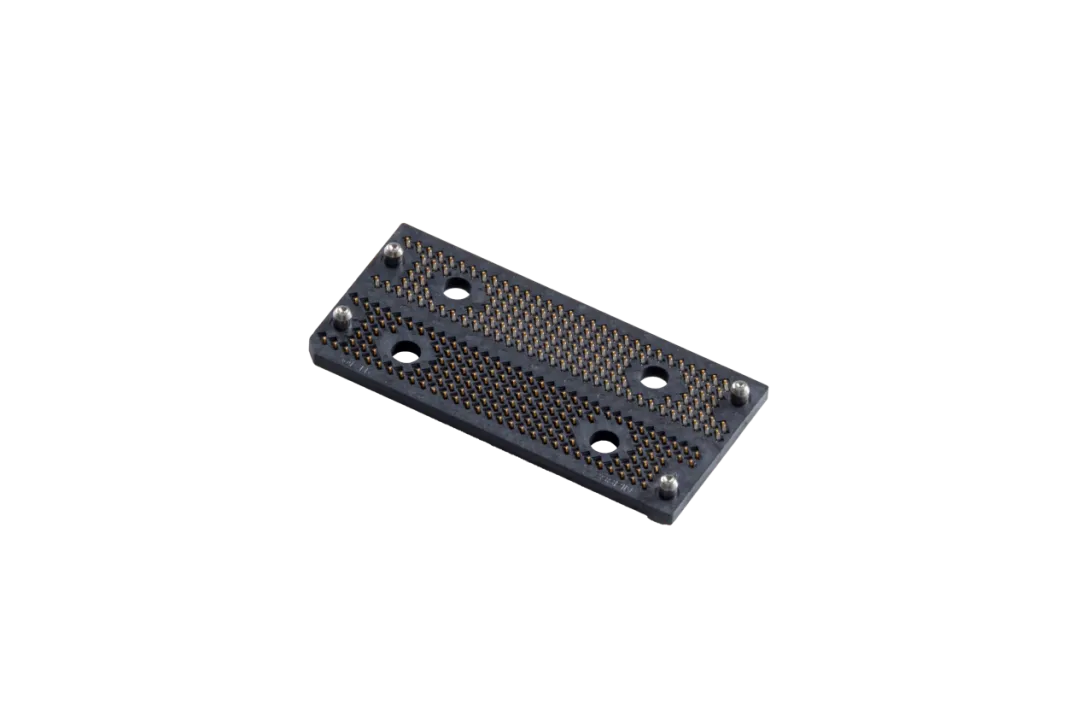
In memory applications, CAMM2 and SO-CAMM2 have further broadened the scope of compression-based technology. Specifically, SO-CAMM2 targets AI servers and high-performance computing applications, offering new choices for system design in memory bandwidth, spatial configuration, and power efficiency.
In terms of board-level interconnects, U-Quin has further extended its compression-based connection technology to CABB (Compression Attached Board-to-Board), offering customized interconnect solutions for diverse computing platforms.
CABB achieves reliable contact through a compression mechanism, eliminating the need for traditional horizontal insertion and extraction strokes. This helps reduce system height, minimizes structural constraints caused by insertion forces, and provides greater design flexibility for airflow optimization, module upgrades, and future maintenance.
More importantly, CABB can be customized according to customers’ system architectures, accommodating various module forms and board layouts.
With the advancement of ASICs and in-house acceleration platforms, computing systems are increasingly demanding diverse requirements regarding memory capacity, module form factors, and board configurations. As a result, customized memory modules have become a key application focus for U-Quin in the CABB space.
Compared to standardized interconnect solutions, customized products require connector manufacturers to understand customer platform design needs earlier and to participate actively in structural configuration, interface design, and product validation from the early development stages.
For U-Quin, the significance of the CA series lies not only in introducing more product specifications but also in gradually building a compression-based interconnect technology platform capable of scaling across different applications.
Leveraging its mature manufacturing foundation – over 300 million units annually shipped in DDR SO-DIMM and M.2 combined – U-Quin has now surpassed one million cumulative shipments of the CA series, continuously extending its existing design and mass production expertise into next-generation high-speed interconnect products.
While the CA series is still in the phase of ongoing market expansion compared to U-Quin’s over 300 million cumulative shipments of DDR SO-DIMM and M.2, surpassing one million units indicates that compression-based interconnect products have moved beyond technical development toward actual manufacturing and large-scale delivery.
In server internal interconnects, U-Quin does not rely on a single solution path.
As ASICs and custom acceleration platforms evolve, system requirements for memory capacity, module form factors, and board layouts are becoming increasingly diverse. U-Quin views customized memory modules as a key application area for CABB, aiming to engage earlier in customers’ system architecture planning and solution evaluation through adaptable interconnect designs tailored to platform-specific needs.
The Slim Card Edge, launched in July this year, features a cross-board structure supporting PCIe Gen 5 and integrates power and signal within a single interface, offering an alternative option for high-speed server expansion and space optimization.
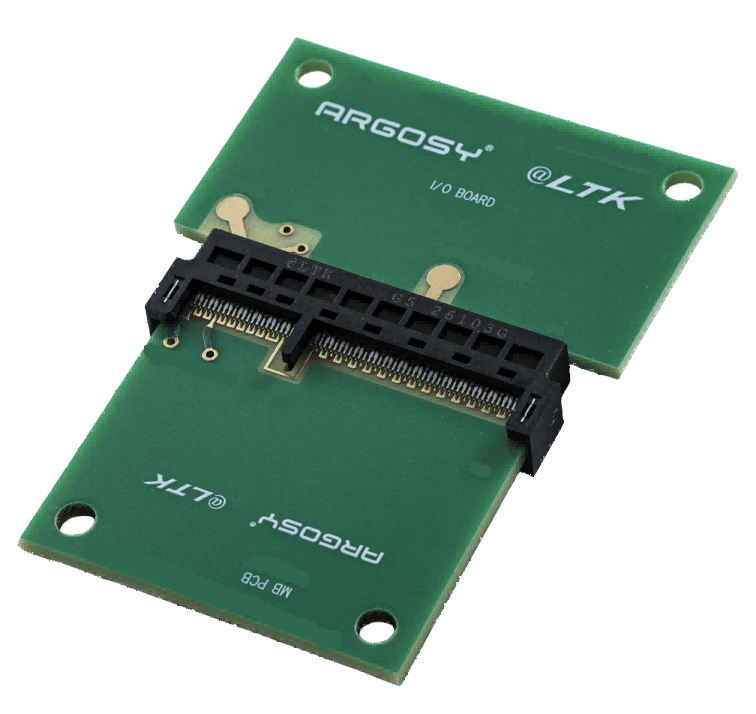
For applications where server internal space is limited and expansion cards are difficult to visually align with the motherboard, Floating Board-to-Board enables floating structures to absorb certain assembly misalignments, providing greater design flexibility for blind mating and board-level assembly.
“These products each serve distinct purposes,” Chen Bo concluded. “U-Quin aims to meet customers’ growing diversification of needs through multiple technological approaches.” Together, they point to a shared insight: the interconnect solution for next-generation servers will not be a one-size-fits-all answer, but rather a set of options.
04
The Next Battle in Design: From “Designing” to “Mass Production”
One aspect repeatedly emphasized by Chen Bo is not as immediately visible as product specifications, yet it represents a more realistic threshold for the industry.
“The performance of high-speed connectors depends not only on product design but also closely on manufacturing processes such as mold making, stamping, injection molding, assembly, and testing.”
This is precisely why Youqun emphasizes vertical integration and automated production: tightly linking design development with manufacturing processes, and concentrating resources on critical parameters like terminal geometry, flatness, positional accuracy, and electrical testing – these seemingly dry metrics determine whether a product can transition from “sample validation success” to “consistent mass production.”
In terms of production layout, Youqun has already established manufacturing sites in Hsinchu, Kunshan, Suining, and Vietnam. The Xuan An facility in Vietnam officially commenced operations in January 2026, with DDR5 SO-DIMM and M.2 products already in full production. The site has obtained ISO 9001 and ISO 14001 management system certifications. This cross-regional production network further strengthens Youqun’s capabilities in capacity planning, supply chain resilience, and customer service.
Looking ahead at next-generation AI servers and data center platforms, Youqun has proactively developed connection technologies for DDR6 DIMM Sockets, M.2 Gen 6, and PCIe Gen 6, targeting future applications in memory, storage, and high-speed expansion. The company aims to engage earlier in customers’ new platform design and validation processes. Built upon its vertically integrated mass production capability, Youqun ensures reliable delivery of high-speed connectors for current AI servers while continuously preparing for future interface standards, accumulating technological advantages for long-term growth.
Finally
From computer peripherals and storage products in 1987, to entering electronic components manufacturing in 2009, and being invited to participate in DDR5 connector standard development in 2018, Youqun Technology’s 39-year journey is a history of “constantly pushing its own position forward within the ecosystem.”
In the past, the connector industry focused primarily on specifications, capacity, and delivery. But in the AI era, as interface standards and system architectures rapidly evolve, connector manufacturers are moving further upstream. Beyond stable mass production, companies now need to master high-speed connector design, precision manufacturing, and the ability to co-validate new platforms with customers.
At booth A10 during ODX 2026, Youqun Technology’s answer is clear – don’t wait for the architecture to be finalized; get to the table early.