

In automotive and industrial electrical systems, connectors are small but decisive components. They determine whether current and signals travel safely and reliably. As equipment becomes more sophisticated, 4-pin connectors have emerged as a common choice because they balance cost, functionality, and durability.
What Is a 4-Pin Connector?
A 4-pin connector is an electrical interface with four independent contact points. The typical pinout includes:
- Power (positive)
- Ground (negative)
- Signal line
- Control or protective line
Compared with 2-pin or 3-pin designs, a 4-pin setup gives engineers more freedom: it can carry power while simultaneously transmitting control or feedback signals.
Think of the 4-pin connector as a multi-lane highway—not only can cars (current) move, but there’s also a dedicated lane for emergency services (signal/feedback).
Installation and Maintenance Tips
The lifespan of a connector depends heavily on how it’s installed. Here’s a practical checklist:
- Inspect before use
Make sure the housing and contacts are free from cracks, corrosion, or debris. - Strip and crimp properly
Use the manufacturer-recommended crimping tool. Poor crimps cause resistance and heat buildup. - Apply protection
In outdoor or wet environments, add heat-shrink tubing or rubber seals. - Test thoroughly
- Use a multimeter to confirm voltage and resistance.
- Perform a pull test to ensure the cable doesn’t slip out.
- Use a multimeter to confirm voltage and resistance.
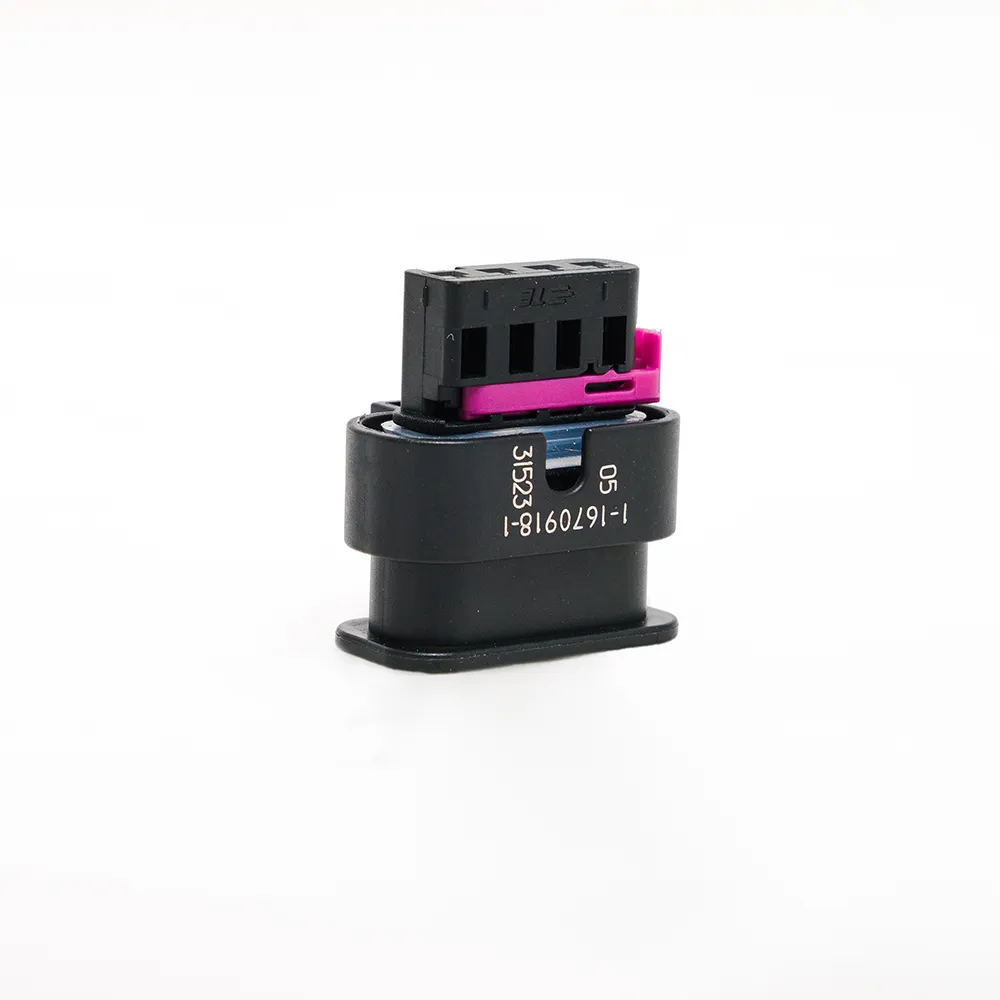
Tiandian 4-Pin Connector Range
According to Tiandian Connector’s 4-pin catalog, there are several styles designed for different industries:
- Waterproof 4-pin connectors – for automotive lighting and engine bay sensors.
- Circular 4-pin connectors – common in heavy-duty machinery and industrial automation.
- Flat 4-pin connectors – compact designs used in small electronics and signal wiring.
Key features:
- High-temperature resistant materials for engine environments.
- Locking designs that prevent accidental disconnection.
- Anti-corrosion coatings to extend service life.
Practical Comparison Table
| Application | Pin Layout Example | Key Benefits |
| EV Charging (SAE J3105) | +DC, −DC, PE, Control Pilot | High-power charging + smart communication |
| Automotive ECU Sensor | Power, Ground, Signal, Feedback | Stable data transfer, noise immunity |
| PC Fan Connector | Power, Ground, Tachometer, PWM | Intelligent speed control, energy savings |
| Industrial Equipment | Power, Ground, Dual Signal | Rugged housings, built for tough environments |

The 4-pin interface is favored for its optimal balance of adaptability and ruggedness. Compared to 2-pin connectors that only deliver power, and 3-pin connectors that add basic signal handling, a 4-pin connector adds another layer: control or feedback.
Quick rule of thumb:
- Use 2-pin when you only need simple power.
- Use 3-pin when you need power plus a single signal.
Use 4-pin when you need power, ground, and smart control/feedback in one package.