

The Birth of Nylon Connectors
When aviation connectors were difficult to popularize due to their large size and high cost, nylon connectors emerged. These multi-pin plastic connectors made mainly of nylon not only offer high cost-effectiveness but also meet the specific requirements of the automotive industry.
It adopts injection molding technology to form a pair of rectangular mating shells, with shovel-shaped terminals inside. A contact locking mechanism is used to achieve a stable connection. In addition, the addition of a rubber protective sleeve provides effective protection for the connection point, enhancing its reliability in various environments.
The integration of electronic technology
In the second half of the 20th century, electronic technology began to gradually integrate into automotive electrical systems. From voltage regulators to electronic fuel injection system actuators, from wiper controllers to lighting and wiper control systems, the presence of electronic technology is everywhere. This transformation not only enhanced the performance and safety of automobiles but also laid a solid foundation for their future intelligent development. Signal processing and sensing functions have also increasingly become integral parts of this emerging field, and wiring harness layouts have gradually become more dense to meet the connection requirements of increasingly complex and precise automotive components.
Modern Wiring Harness Design
With the continuous advancement of the automotive industry, modern wiring harness design has also shown diverse characteristics. From the variety of wire cross-sectional areas, rubber sleeves, and connection device types to customized designs for specific application scenarios, modern wiring harness design has found the perfect balance between cost-effectiveness and reliability. These innovations not only enhance the electrical performance of automobiles but also provide unlimited possibilities for future technological innovations.
Electronic engine management systems
At the same time, as the United States implemented stricter regulations on fuel efficiency and European manufacturers delved deeper into the performance advantages of fuel injection technology, electronic engine management systems began to be gradually adopted. The introduction of this system not only enhanced engine efficiency and reduced emissions, but also provided strong support for the intelligent and environmentally friendly development of automobiles.
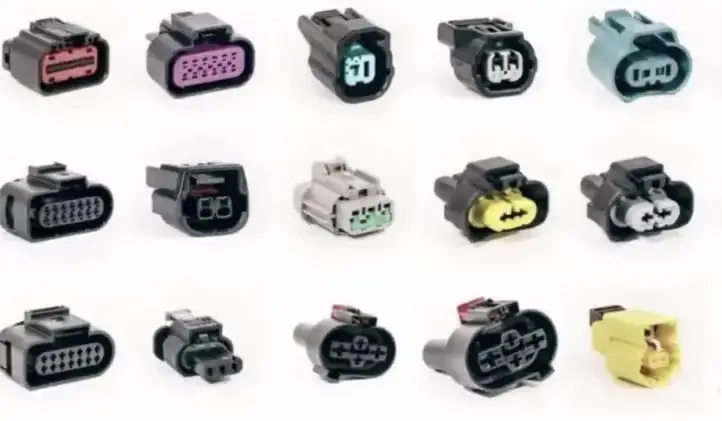
The standardization and diversification of connectors
Today’s multi-pin electrical connectors are exquisitely designed and highly functional, capable of supporting up to 100 connection points, with performance comparable to that of aviation connectors. These connectors are made of precisely manufactured brass or copper, alloy sheets, which are formed into cylindrical pins and their corresponding sockets through stamping and folding processes. The shell designs are not limited to rectangular shapes; complex designs are also common and are equipped with a variety of integrated positioning keys to ensure precise and stable connections. These connectors’ shells are typically rectangular in design, but complex shapes are also widespread and are equipped with a variety of integrated positioning keys.
Various forms of wedge-shaped locking.
The internal hardware terminals are mostly processed by stamping and lathe methods. With the rapid rise of the new energy vehicle market, some enterprises in the current low-voltage wiring harness terminal market have been unable to meet market demands due to their technical level and lack of innovation. Because automotive wiring harness terminals are no longer simple connection devices, but rather higher-level components that integrate devices and control systems.