
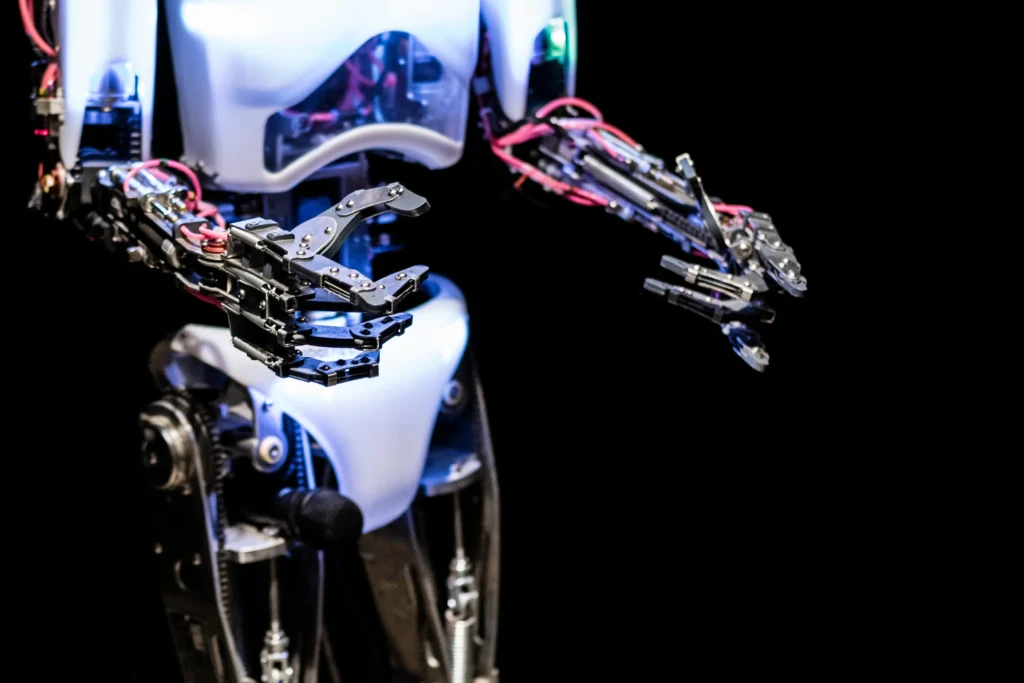
On August 19, Unitree Robotics (688836.SH) debuted on the STAR Market at a price of 150.80 yuan per share, with an initial market capitalization of approximately 60.993 billion yuan, officially establishing itself as the first humanoid robot company listed on the A-share market.
More attention than its valuation, however, is being drawn to its mass production pace. According to the prospectus, Unitree expects to ship over 5,500 humanoid robots in 2025 – securing the global market leadership position. For the full year of 2025, revenue reached 1.699 billion yuan, up 332.3% year-on-year, while non-GAAP net profit hit 591 million yuan, a surge of 674.29% compared to the previous year.
As of July 2026, Unitree has cumulatively produced 18,000 pure bipedal humanoid robots. According to Nikkei Asia, Owen Chan, Asia-Pacific Director at Unitree, said that total shipments in 2026 are expected to at least double those of 2025 – and could even approach triple the volume.
While investors are focused on valuations, the connector supply chain is calculating a different equation: as humanoid robots transition from hundreds or thousands to tens of thousands of units shipped annually, how much additional connectivity demand does each unit generate? And when will this demand translate into concrete orders and actual revenue?
01
How Many “Connections” Does One Humanoid Robot Need?
Connectors are nearly ubiquitous in every humanoid robot.
Sensing System: Depth cameras, LiDARs, IMUs, six-axis force sensors, tactile sensors, joint encoders, and foot pressure sensors are distributed throughout the body. Each sensor must transmit signals back to the main controller, requiring high-speed signal connectors and miniature sensor interfaces. With the rapid growth of multimodal sensors, demand for high-speed data connectors is accelerating particularly sharply.
Decision and Control System: One motherboard runs AI large models for task planning, while another runs a real-time operating system for motion control. Within domain controllers, high-speed backplane and board-to-board connectors are required; signals between the main controller and joints are aggregated via high-speed copper cables and bus harnesses. As computing power increases, demand for ultra-high-speed connectors exceeding 25 Gbps is growing rapidly.
Actuation and Drive System: This is the segment with the highest connector usage and value. A single humanoid robot contains dozens of joints, each requiring power and signal connections for motors, drivers, and encoders within the joint modules. Cables for linear and rotary actuators account for the largest cost share. Inside dexterous hands, arrays of miniature connectors pack extremely high density into very limited space. The industry is shifting from “generic industrial standard components” toward “dedicated humanoid robot architectures,” with miniaturization and high insertion/extraction durability becoming core technological trends.
Power and Communication System: Batteries, BMS, power distribution units, and system-wide communication buses require high-current, high-voltage connectors, power connectors, and grounding/EMC protection connectors. While unit prices here are relatively high, the technology is more mature and largely adapted from the new energy vehicle sector.
According to MIR Industrial Research, assuming conservatively 100 connectors per humanoid robot, each valued at 30–50 yuan, the total connector value per unit ranges from 3,000 to 5,000 yuan. At mass production volumes reaching one million units, this could create a 3 – 5 billion yuan incremental market. Open-source Securities research indicates that a single Tesla Optimus robot uses over 100 connectors, corresponding to a value of 3,000 – 5,000 yuan.
QY Research statistics show that the global humanoid robot connector market was worth approximately $724 million in 2025, projected to reach $1.372 billion by 2032, with a compound annual growth rate of 11.3%.

02
Who Has Already Secured Orders?
Market projections paint a long-term picture, but investors care more about the present – when manufacturers like Unitree, UBTech, and Zhiyuan are ramping up their production lines, which players in the connector supply chain have already landed tangible orders?
First-tier suppliers: Those already delivering in bulk or entering mass production.
Kaiwang Technology (301182.SZ) serves as a precision cable connector supplier for Unitree Technology, maintaining a stable and continuous partnership. Its products are high-flexibility, high-reliability specialty cables designed for complex bending and high-frequency motion scenarios. This is currently the deepest collaboration with a leading system integrator and the longest-running supply relationship. However, the company notes that this business accounts for less than 1% of its total revenue and will not significantly impact performance in the short term.
Zhucheng Technology (301280.SZ) has established a subsidiary in Foshan, focusing on R&D and application of connectors for industrial and humanoid robots. The company has partnered with Ubtech, securing sample orders currently in validation phase; it has also obtained KUKA’s supplier code and begun mass deliveries. According to its 2025 annual report, industrial connectors have already been supplied to Ubtech. Automotive connectors remain its core business, while robotics represents a clear growth driver.
Laimu Co., Ltd. (603633.SH) confirmed on August 17, 2026, via an interactive platform that some of its products – including connectors, wire harnesses, and injection-molded exterior components – have secured customer qualification and entered small-batch production. Public information shows that its products have gradually received certifications from clients such as Zhiyuan and Xingdong Jiyan, with some already in mass production.
Second-tier players: Sample validation underway, revenue contribution still minor.
Dianlian Technology (300679.SZ) has strong technical expertise in miniature RF connectors. However, it explicitly stated on the interactive platform that overall revenue from robotics and AI server applications remains relatively small, with the business still in development stage, and future expansion and scale-up remain uncertain.
Weifeng Electronics (301328.SZ) lists humanoid robots as its “fourth major business segment,” but recently clarified that related products have not yet entered mass production and will not significantly affect earnings.
Third-tier players: Products ready, awaiting customer breakthroughs.
Leading companies including Ruike, AVIC Optoelectronics, Luxshare Precision, and Derun Electronics all possess technological reserves and product capabilities, with some already appearing on upstream supplier lists for humanoid robot wiring harnesses. However, no definitive mass-supply announcements have been made. These firms are characterized by “capable but not yet scaled.” Once downstream OEMs ramp up large-scale production, their capacity and customer advantages could quickly materialize.
03
When Will the Growth Materialize?
The key variable is shipment volume. In the first half of 2026, the global humanoid robot market showed signs of explosive growth.
According to Smart Analytics Global, global humanoid robot shipments reached approximately 19,100 units in the first half of 2026, nearly tripling year-on-year, with Chinese manufacturers accounting for over 97%. Omdia data indicates that global shipments hit around 13,000 units in 2025, with the top six suppliers all being Chinese companies.
Multiple institutions are rapidly revising upward their forecasts:
Morgan Stanley raised its 2026 forecast for China’s humanoid robot shipments to 50,000 units in June this year, projecting 446,000 units by 2030, representing a CAGR of about 106% between 2025 and 2030. Goldman Sachs expects global shipments to reach 76,000 units in 2027 and climb to 502,000 units by 2032.
Based on these projections, the realization of connector growth can be divided into three phases:
2026: Validation Year. Shipments expected between 50,000 and 100,000 units, translating into direct incremental market value for connectors and wire harnesses of approximately 400 million to 750 million yuan. This volume is sufficient to shift robotic-related revenues from negligible to meaningful contributions for connector makers, though likely insufficient to alter any company’s overall revenue structure.
2027 – 2028: Scaling-Up Years. With Unitree’s new factory (planned annual capacity of around 20,000 units) coming online and scaling toward a target of 30,000 units per year, along with increased output from other domestic leaders, shipments could advance toward 200,000 to 400,000 units. By then, the robotics revenue of individual connector manufacturers could exceed 100 million yuan. Companies in the second tier that have passed validation may enter the market in bulk, shifting the industry focus from “who has orders” to “who offers better yield and lower costs.”
Around 2030: The structural year. If shipments reach 400,000 to 700,000 units, humanoid robot connectors will transition from a “conceptual theme” into a niche market worth billions annually – provided shipment volumes meet expectations.
Conclusion
Unitree’s listing is a signal: the “mass production narrative” of humanoid robots has moved from PowerPoint presentations to actual production lines. For the connector supply chain, the real test isn’t whether there’s demand, but rather three key financial statements:
Who has already secured customer design wins?
Who has started mass deliveries?
Whose robotics business has truly appeared on the profit and loss statement?
The real growth will emerge from these three statements.