
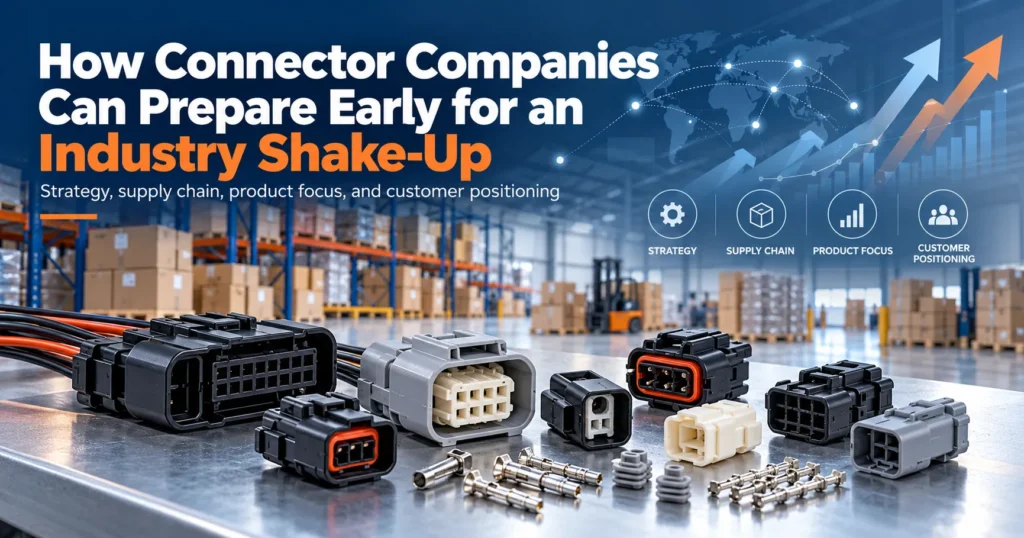
In the next three to five years, the domestic connector industry will enter a period of accelerated consolidation. The global market is highly concentrated, while the domestic market still exhibits the characteristics of “large market, small enterprises, and low concentration”. Rising costs, price competition, the elimination of low-end production capacity, increased customer compliance requirements, and active mergers and acquisitions by listed companies are all jointly driving changes in the industry landscape. For small and medium-sized enterprises, this is both a pressure and a period for adjusting business models, clarifying their own positioning, and preparing for capital markets. The earlier they standardize and plan, the more likely they are to maintain an active position in the next stage.
01
Industry reshuffling is an inevitable trend.
Business owners should adapt to this trend.
The increase in industry concentration is a necessary path that any mature industry must go through.
From steel, automobiles to home appliances and mobile phones, almost every industry has undergone an evolution from “a hundred boats competing” to “domination by a few leaders”. Scale effects, technical barriers, brand premiums, and capital advantages will naturally drive resources to concentrate in the hands of leading enterprises.
At present, the global connector market has formed a highly concentrated pattern. According to data from Bishop & Associates, the global connector market size is approximately $90 billion in 2025, and the top five manufacturers – TE Connectivity, Avnet, Molex, Amphenol, and Foxconn – together account for 35% of the market share. The top ten enterprises in the world are expected to account for 61.8% of the industry’s total revenue. The increase in industry concentration is mainly due to the high-end product research and development barriers and long customer certification cycles, and the participation of small and medium-sized enterprises in high-speed transmission and high-reliability scenarios is continuously narrowing.
The reshuffling of the domestic connector industry is also underway. This is not a question of “whether it will happen”, but a question of “is it happening and can you avoid it or not”.
For the vast number of small and medium-sized enterprises in the Shenzhen Connector Industry Association, this is both a challenge and an opportunity. Guangdong region has the densest connector industry chain enterprises in the country, from mold processing, precision injection molding, stamping to electroplating and assembly, with a rare global ecosystem of support. However, this “density” also means that the intensity of competition is far greater than in other regions. The reshuffling in Guangdong will come faster and more fiercely. Business owners must face the reality, adapt to it, and cannot have any attitudes.
02
The reshuffle in the foreign connector industry has basically been completed.
In China, it has already begun.
01
Global landscape: Monopoly is inevitable
The combined market share of the five leading companies – TE Connectivity, Molex, Avnet, Longchuan Precision and Hon Hai Precision – is expected to reach 43.7%.
International giants continue to expand their business through continuous mergers and acquisitions. Avnet’s revenue is expected to exceed 23 billion US dollars in 2025. It completed three mergers in 2025 – Compaq’s mobile network business, Compaq’s connection and cable solutions division, and Trexon. Molex completed the acquisition of Smiths Interconnect in the UK in 2026. The United Way Group made a cross-border acquisition of Singapore’s Interplex Datacom for 850 million US dollars.
The global connector industry has already reached a typical oligopoly pattern.
02
Current situation in China: Large market, small enterprises, severely insufficient concentration
China is the world’s largest connector market, accounting for 33.12% of the global market share in 2025. However, the concentration level of the domestic market is far lower than the global level.
In 2024, the largest domestic connector company, Zhonghang Optoelectronics, only accounted for approximately 11%. Most listed connector companies have a scale of 10-20 billion yuan. The concentration level of the domestic connector market is not high, and the market resources are relatively scattered, resulting in intense industry competition.
In a country with a market accounting for one-third of the global market, the share of the largest enterprise is only 11%. This gap is the space for reshuffling.
What’s more worrying is that foreign enterprises still occupy over 50% of the Chinese connector market share. In 2025, the local substitution rate of the Chinese connector industry increased from 34% in 2020 to 45.9%, but still more than half of the market is in the hands of foreign enterprises.
03
The industry is becoming increasingly competitive, and the conditions for a shakeout have matured.
In the first half of 2026, among the 23 major listed connector companies, 19 saw revenue growth, but only 8 saw profits increase simultaneously. More than half of the companies became less profitable as they expanded. The era of blindly expanding and making money passively has completely come to an end.
The industry’s differentiation is alarming: AVIC Optoelectronics had a revenue of 11.24 billion yuan and a growth rate of only 0.50%, with a significant 22% drop in net profit; Dingtong Technology had a revenue of 1.029 billion yuan and a growth of 31.17%, with a 59.24% increase in net profit – even though both are engaged in connector production, the difference in net profit margins is astonishing.
What is even more alarming is that in the period from 2025 to 2026, a number of factories such as Dongguan Jiafeng Electronics, Jinbao Electronics, Huaing Electronics Plastics, and Wuzhi Electronics closed down one after another. Jiafeng mainly produces low-end connectors, with a gross profit margin of less than 8%. The elimination of low-end production capacity is the most direct signal of industry shakeout.
At the same time, the copper price has approached the high level of 100,000 yuan per ton, and the pressure of raw material price increases is almost entirely borne by the suppliers alone. In the “advance payment” ecosystem prevalent in the new energy industry, many small connector manufacturers are worried about cash flow breakdown and find themselves in an awkward situation of “having orders but not daring to accept them”.
Costs are rising, prices are falling, and profits are being squeezed from both ends. The conditions for a shakeout are completely mature.
03
Small and medium-sized enterprises should gradually standardize their operations.
And prepare for integration into the capital market
In the next three to five years, small and medium-sized enterprises in the connector industry will face a life-or-death test. Standardized operation is the only way for these enterprises to survive and gain recognition from the capital market.
01
Why do small and medium-sized enterprises need to be standardized?
First, the “Golden Tax Project 4.0” has been fully implemented.
Tax supervision has completely shifted from “taxing based on invoices” to “taxing based on data”. Tax-related data from multiple departments such as industry and commerce, banks, social security, and customs are shared in real time, enabling comprehensive and penetrating monitoring of enterprises’ operational data. In the “data-based tax management” era, the cost of passively waiting for audits and interviews is much higher than actively self-checking and correcting. In the first half of 2026, 69 A-share listed companies issued announcements regarding tax corrections and tax penalties, totaling over 4.9 billion yuan in additional taxes and penalties paid.
Second, high-quality customers only choose standardized suppliers.
Listed leaders such as Huafeng Technology and Ruijie actively included 80% of their upstream and downstream small and medium-sized enterprises into their unified quality co-management system. If they cannot enter the supply chain of large enterprises, they cannot enter the future of this industry. And the prerequisite for entering the supply chain of large enterprises is standardized operation.
Third, connecting with the capital market requires standardization.
Whether it is independent listing in the future or being acquired by a listed company, financial and legal standardization are prerequisites. The earlier the standardization is achieved, the lower the cost; the later it is delayed, the greater the cost.
02
How to start with standardized operation for small and medium-sized enterprises?
The first step (immediately): Self-examination and rectification. In accordance with the requirements of the Golden Tax Phase IV, conduct a comprehensive self-examination of financial, tax, social security and contract matters. Rectify problems promptly upon discovery.
Step 2 (Short-term): Establish the system. Establish a standardized financial accounting system, a complete internal control system, a sound contract and personnel management system. These “basic skills” are the foundation for standardized operation.
Step 3 (Medium-term): Seek qualifications. Actively apply for the recognition of a national high-tech enterprise, make full use of the policy benefits – reducing the corporate income tax from 25% to 15%, and implementing the additional deduction for research and development expenses, etc.
Step 4 (Long-term): Connect with capital. Enterprises with the necessary conditions can consider listing on the New Third Board. First, make the management operation standardized, to create conditions for future independent listing or being acquired by a listed company.
03
Merger and acquisition is also a way out
In the current context of accelerated industry consolidation in the connector sector, being acquired by a listed company is an important path for many small and medium-sized enterprises to realize value appreciation. However, when listed companies make acquisition decisions, they will prioritize companies with standardized operations. If the finances are not standardized, the legal affairs have flaws, and the management is not transparent, the integration risk after the acquisition will be extremely high, and the willingness of listed companies to make acquisitions will significantly decrease.
During the reshuffle, only enterprises with standardized operations have bargaining chips – whether for independent development or being acquired.
04
The industry reshuffle has provided rare opportunities for leading enterprises and listed companies.
For leading enterprises and listed companies in the industry, this reshuffle does not pose a threat; instead, it presents a historic strategic opportunity.
01
The window period for low-cost mergers and acquisitions has opened up.
Currently, the valuations of small and medium-sized enterprises in the industry are at a relatively low level. For listed companies with abundant funds, this is precisely the best time to acquire high-quality targets at reasonable prices.
In October 2025, Xin Yin Electronics acquired 80% of the equity of Guolian Electronics for 220 million yuan, precisely entering the core of the new energy vehicle connector. Guolian Electronics’ customers include Linken Precision, TE Connectivity, and terminal services for mainstream automakers such as BYD, Loco, and Xiaomi. By the first half of 2026, this acquisition directly contributed consolidated revenue, and Xin Yin Electronics’ revenue increased by 43.41%.
In December 2025, Hualing Cable acquired 70% of the equity of Sanzhu Technology for 183 million yuan, connecting the two key technical links of “cable” and “connector”.
In April 2026, Weifeng Electronics acquired 36.25% of the equity of Weitai Precision for 1 yuan, laying out high-speed board-end connectors.
In May 2026, Suilian Co., Ltd. announced its intention to acquire no less than 51% of the equity of Huahui Industrial, with an overall valuation not exceeding 250 million yuan. By August, it finally obtained 60% of the equity of Huahui Industrial. Huahui Industrial specializes in special connectors and automotive components, and its customers include mainstream automakers such as Changan and Ideal.
Electronic Link Technology, Lingyi Manufacturing, Zhucheng Technology… Mergers and acquisitions cases follow one after another.
Powerful enterprises are rapidly expanding through mergers. If you don’t act now, in three years, you may not even be able to find suitable merger targets to pursue.
02
The benefits of accelerated market concentration
As a large number of small and medium-sized enterprises withdraw from the market, the leading enterprises will gain a huge market share. The concentration of the top ten global connector manufacturers is increasing year by year. The market concentration in the domestic market is much lower than the global level, and the growth space for the leading enterprises is particularly promising.
03
The historic opportunity for domestic substitution
Foreign manufacturers account for over 50% of the connector market in China. In high-tech fields such as military, new energy, and data centers, the share of domestic connectors is rapidly increasing. Leading enterprises with technological breakthrough capabilities will gain excess returns in the wave of domestic substitution.
04
From “selling components” to “selling solutions”
The industry is shifting from the sale of individual components to modularization and system-level solutions. Whoever can transform from a “component supplier” to a “system solution provider” will be able to earn higher profits and enjoy stronger customer loyalty.
If the leading enterprises do not act now, they are essentially giving the opportunity to their competitors.
05
Mergers and acquisitions are the main way for industry reshuffling.
To achieve success, comprehensive management throughout the process is necessary.
Mergers and acquisitions are the core means to promote industry consolidation and enhance concentration. However, they are not merely simple capital operations; they are a systematic project that requires strategic thinking, organizational support, risk control, and meticulous integration throughout the entire process.
01
The “Four Pillars” of Mergers and Acquisitions
First, mergers and acquisitions strategy review. The first step is to address the questions of “why merge” and “what to merge”. Set clear strategic goals for the next 3-5 years and accurately “profile” potential targets – establish valuation, scale, technology, customer, culture, etc. as screening criteria to avoid hasty decisions.
Second, merger and acquisition operation organization. Establish a full-process organizational structure from strategic planning, project search, due diligence to integration. Through the collaboration of professional teams and external advisors, achieve scientific decision-making.
Third, merger and acquisition risk control. Risks run through the entire process of mergers and acquisitions. During the due diligence process, not only financial and legal aspects should be considered, but also hidden risks such as technology, customers, and culture should be deeply explored.
Fourth, merger and acquisition integration management. Integration is the true test of the success or failure of mergers and acquisitions. A merger and acquisition integration steering committee needs to be established, a detailed integration plan should be formulated, and the contingency plan should be completed before the transaction announcement.
02
Ten “Rules of Engagement” for Merger Integration
Initiate early: The integration team should get involved during the due diligence stage and identify the difficulties in advance.
Build the system: Clearly define the organizational structure and processes for integration to avoid chaos.
Determine the integration model: Choose the absorption, independence, feedback or co-progression model based on the characteristics of both parties.
Formulate a strict plan: The integration plan must be completed before the transaction announcement.
Win by speed: Release the new organization and personnel arrangements on the first day of the deal, quickly stabilizing the troops’ morale.
Prioritize sales and customers: Stabilizing core customers is a guarantee of cash flow.
Comprehensive communication: Develop communication strategies for shareholders, employees, customers, and suppliers.
Retain key talents: Quickly identify the candidates for key positions and, if necessary, offer retention incentives.
Emphasize cultural integration: Design a integration plan to avoid “two different skins”.
Establish an evaluation and review mechanism: Assess the integration performance in stages and continuously optimize.
03
The Implications of Zhucheng Technology’s Acquisition of Ruosen Electronics
In the practice of Zhucheng Technology’s acquisition of Ruosen Electronics in 2025, it was strategically clear to strengthen the precision stamping and injection molding capabilities. A cross-departmental team was formed to jointly conduct due diligence, and the 100-day integration plan was completed before the business registration changes. On the first day of the transaction, the new organizational structure and core team were announced. The chairman personally visited Ruosen to hold a meeting with employees to stabilize their morale. The integration team immediately connected with customers to ensure a smooth transition of orders. Thanks to the systematic acquisition management, Ruosen Electronics achieved performance growth that year and formed significant synergy with Zhucheng’s original business.
Acquisition is not just about buying; integration is the real test.
Conclusion
In the next three to five years, the connector industry will undergo a profound upheaval.
For the leading enterprises: This is a strategic opportunity period for them to grow bigger and stronger. Low-cost mergers and acquisitions, concentrated market share, and accelerated domestic substitution – the combination of these three benefits means that they must act now or miss the strategic opportunity period.
For small and medium-sized enterprises: This is a critical transition window period. They must either establish differentiated barriers in specific fields, or operate in a standardized manner and wait to be acquired, or be eliminated by the market. There is no fourth way.
For the entire industry: This is a qualitative change period from dispersion to concentration, and from low-end to high-end.
After the upheaval, the surviving enterprises will have stronger competitiveness, higher market share, and healthier profit models. The eliminated enterprises will either become the price paid for industrial upgrading.
The vast number of small and medium-sized enterprises in the Shenzhen Connector Industry Association, please remember these three sentences:
First, the upheaval has begun. We need to face it and respond.
Second, standardized operation is the only way to survive. The earlier you standardize, the lower the cost.
Third, being acquired is not a failure, but a way to realize value.
The future of the connector industry does not belong to all enterprises, but definitely to those with vision and preparation.