

Although the global connector market remains dominated by Western and Japanese giants in high-end segments, domestic substitution is shifting from “cost-driven” to a dual engine of “technology and service,” with growing opportunities emerging for local manufacturers in industrial automation, new energy, and automotive electronics.
Take Weifeng Electronics (stock code: 301328) as an example. This manufacturer, originally focused on industrial control connectors, reported revenue of 713 million yuan in the past year – a 33.46% increase year-on-year. Its “one body, two wings” strategy-centered on industrial control with automotive and new energy sectors as supporting pillars – is now clearly reflected in its financial performance. During the 2026 Munich Shanghai Electronica exhibition, Weifeng Electronics unveiled new products including IP69K waterproof board-to-board connectors, mixed-signal current and power connectors, and three-axis floating BTB connectors, while also identifying AI computing power as its “fourth business segment.“
At the exhibition, a reporter from International Cable & Connection conducted an exclusive interview with Fu Jiajun, Director of Marketing Center at Weifeng Electronics, engaging in in-depth discussions on topics including new product technology highlights, the “one body, two wings” research and production system, global manufacturing capacity layout, and the path toward domestic substitution.
International Cable & Connection: What core products and new technologies did Weifeng Electronics bring to this exhibition? What are the key features of these new products and technologies, and what are their application scenarios in the market?
Wei Feng Electronics’ Fu Jiajun: At this year’s Munich Shanghai Electronica, Wei Feng Electronics closely followed the theme of “high precision, customization, and intelligence,” presenting a series of interconnect solutions addressing key industry challenges.
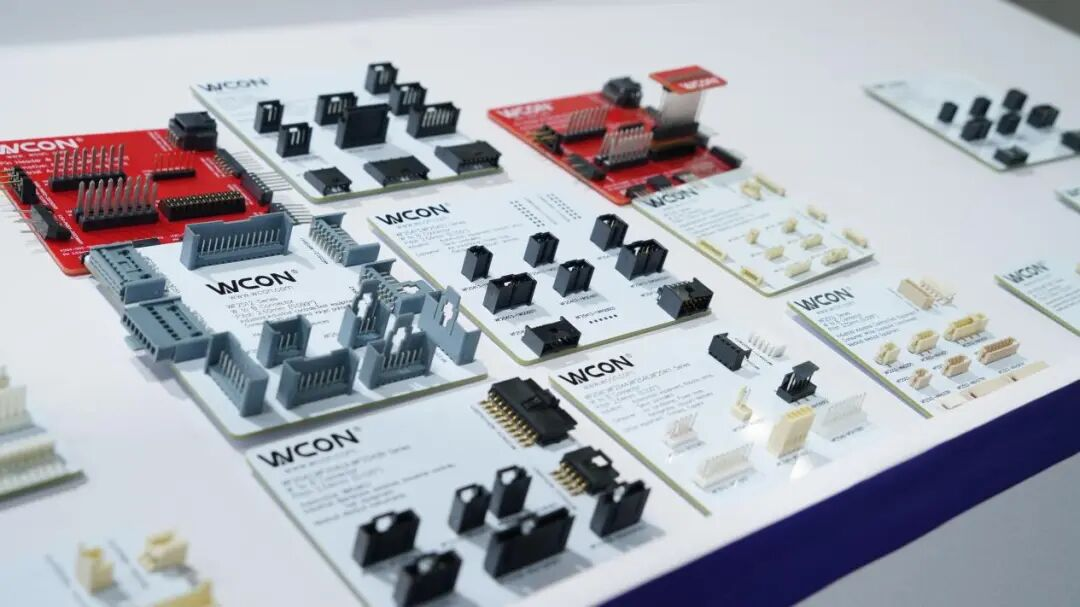
In terms of core products, we have introduced the latest automotive-grade IP69K waterproof wire-to-board connectors, power and signal mixed-configuration connectors, as well as high-tolerance floating board-to-board connectors.
The most notable feature of these new products is their “stable and reliable performance under extreme conditions.” For example, our automotive-grade connector 720001 offers the highest IP67 waterproof rating in a compact design. Additionally, our full range of WAFER products, including precision board-to-board connectors, are already widely used in high-stability applications such as industrial automation control, energy storage systems, the three-electric systems of new-energy vehicles, and robotic joint modules.

International Cable & Connection: At this exhibition, Weifeng Electronics highlighted its IP69K waterproof wire-to-board connectors, fine-pitch wire-to-board/board-to-board connectors, and floating board-to-board solutions. As industries such as industrial automation, energy storage, and new energy increasingly demand higher performance from connectors, what specific steps has Weifeng Electronics taken in product development and strategic planning to meet industry trends toward high reliability, environmental resistance, miniaturization, and high current-carrying capacity?
Wei Feng Electronics’ Fu Jiajun: From an industry perspective, the underlying challenge stems from connectors facing stringent requirements for high reliability, environmental resistance, miniaturization, and high current carrying capacity. Wei Feng Electronics has a clear strategy: product platformization – developing a comprehensive family of wire-to-board and board-to-board products with pitch ranging from 0.4mm to 10.0mm, along with standardized design specifications; proactive testing capabilities – operating its own UL-certified laboratory to complete full reliability validation before mass production; and collaborative pre-research with leading customers – engaging early during new platform development to secure design margins in advance. By leveraging platformized products and early collaboration, we proactively address industry evolution rather than merely applying reactive fixes.
International Cable & Connection: With its development strategy centered on industrial control and supported by automotive and new energy sectors, Weifeng Electronics faces significant differences in reliability and testing standards between industrial-grade and automotive-grade products. How has the company established a research and development and quality control system that is both distinct and synergistic?
Wei Feng Electronics’ Fu Jiajun: “One body, two wings” is our unwavering core strategy. Industrial standards emphasize “long service life and resistance to harsh environments,” while automotive standards impose extremely high requirements on “zero defects, vibration resistance, and consistency,” such as the IATF16949 standard.
To this end, we have established a collaborative system characterized by shared infrastructure at the base and independent operations at the top.
Separately, we have established independent automotive and industrial control divisions. Starting from the APQP phase, our R&D teams, dedicated production lines, and inspection standards are fully independent and meet the highest industry standards for each respective sector.
Synergistically, we possess a laboratory accredited by China National Accreditation Service for Conformity Assessment (CNAS), with full integration across fundamental materials research (such as copper alloy performance and plastic weatherability), mold flow analysis, and simulation technologies. This model enables us to leverage our deep expertise in industrial automation to enhance the reliability of automotive products, while applying automotive-grade quality control standards to improve manufacturing consistency in industrial automation products – achieving a combined effect greater than the sum of its parts.
International Cable & Connectivity: In recent years, major international connector companies have been expanding into emerging fields such as AI computing power and embodied intelligence. What are Weifeng Electronics’ strategic initiatives in these areas?
Wei Feng Electronics’ Fu Jiajun: AI computing power and embodied intelligence are indeed the golden tracks in recent years and for the next decade. Wei Feng Electronics has consistently maintained a sharp market sense. As I mentioned earlier, the company’s current “one body, two wings” strategy across three business segments forms its foundational approach. Building on this foundation, the company is also making strategic moves into areas including AI computing and humanoid robotics, positioning them as the fourth major business segment.
In the field of AI computing power, data centers are seeing a surge in demand for high-frequency, high-speed signal connectors. We are currently increasing our R&D investment to address the challenges of high-speed performance, thermal management, and signal integrity brought by high computational power.
In the field of embodied intelligence, robotic joint motors and sensors require numerous connection solutions that are “miniaturized, lightweight, and highly flexible.” The previously mentioned “fine-pitch wire-to-board connectors” and “high-reliability cable harnesses” actually perfectly meet the internal wiring requirements of robots.
The humanoid robotics industry as a whole has not yet entered large-scale growth. We at Weifeng Electronics aim to be fully prepared with mature solutions when these emerging industries take off.
International Cable & Connection: We understand that Wei Feng Electronics has been continuously expanding in recent years. Last year, its Kunshan production base was completed and began operations, and this year the company further increased investment in its Thailand production facility. Could you please provide an overview of Wei Feng Electronics’ current scale and share how it is positioning itself to meet global customer demands?
Wei Feng Electronics’ Fu Jiajun: As globalization evolves, customers are placing higher demands on supply chains in terms of “safety, agility, and localization,” prompting Wei Feng Electronics to steadily expand its production capacity in recent years.
We have now established a balanced tripartite structure comprising the Dongguan headquarters in South China, the Kunshan base in East China, and the overseas base in Thailand. In 2024, the South China production base at our Dongguan headquarters completed its relocation, further expanding its capacity. Last year, the new Kunshan plant finished its expansion and relocation, significantly enhancing both production capacity and automation levels, thereby strengthening our ability to provide localized support for new energy and automotive customers in the East China region. Meanwhile, the upcoming launch of our Thailand base this year marks a key move in implementing our “going global” strategy.
The Thailand base not only effectively mitigates geopolitical risks arising from international trade frictions, but also enables us to deliver a “local for local” service to customers in Southeast Asia and even Europe and America. Overall, Weifeng Electronics has already achieved the production capacity and risk-resilience required for global delivery.
International Cable & Connection: In the high-end connector sector, international giants from Europe, America, and Japan have long held dominant positions. What are Weifeng Electronics’ core competitive advantages in advancing “domestic substitution”?
Wei Feng Electronics’ Fu Jiajun: Domestic substitution has evolved from being “cost-driven” to being “dual-driven by technology and service.” Compared to international giants, Wei Feng Electronics excels in “superior service and agile responsiveness at comparable quality levels.” While lead times for global manufacturers often stretch into months, we leverage our localized advantages and vertically integrated capabilities across the entire supply chain – from mold making, injection molding, stamping to assembly – to minimize delivery times to an exceptional degree.
At the same time, we are more willing to collaborate with customers on joint R&D in the early stages. Our service and high cost-effectiveness serve as key advantages in winning over leading clients and achieving high-end substitution.
International Cable & Connection: With growing global emphasis on environmental protection and sustainable development, what efforts has Weifeng Electronics made in green manufacturing and ESG?
Wei Feng Electronics’ Fu Jiajun: As a company operating in the global market, ESG is not only a compliance requirement but also a corporate social responsibility.
On the product side, we select halogen-free, environmentally friendly materials that comply with RoHS/REACH standards based on customer requirements. On the manufacturing side, our facilities in Dongguan, Kunshan, and other locations are actively expanding rooftop photovoltaic installations to increase the proportion of green electricity usage, while also implementing energy-saving and emission-reduction upgrades in injection molding, stamping, and other processes.
Conclusion
From its Dongguan headquarters to the Kunshan base and on to its factory in Thailand, from industrial control as its core business to automotive-grade and new energy sectors as its two wings, and then quietly developing AI computing power and embodied intelligence as its “fourth growth curve,” Weifeng Electronics’ strategy – essentially based on shared infrastructure at the foundation level and independent innovation at the top – is fundamentally doing one thing: gradually replacing the long-standing dominance of Western, Japanese, and European players in the high-end connector market with a distinctly Chinese presence.
Domestic substitution has evolved into a dual-drive model of “technology plus service.” As Kunshan strengthens its East China response and Thailand takes on overseas expansion to mitigate risks, Weifeng Electronics aims to tell the next chapter of its story: global delivery.