

AI data centers are rapidly advancing toward 1.6T, while new energy vehicle high-voltage platforms are moving from 800V to 1000V, pushing the connector industry to its limits driven by downstream demand. However, an increasing number of manufacturers have realized that what often holds back progress is not design capability, but rather the physical limitations of upstream materials – copper alloy materials have evolved from “single-requirement specifications” to “system-level solutions.”
At the 2026 Munich Shanghai Electronics Show, Wang Sheng, General Manager of Xinke Materials, was interviewed by a reporter from International Wire & Cable. This copper materials company based in Wuhu, Anhui, has been committed to advancing traditional industries through high-tech innovation, quietly transitioning from being a follower and competitor to becoming a leader, securing a technological edge in the new round of global industrial competition.
01
Industry Challenges
When Connectors Hit the “Material Ceiling”
Every leap in connector performance is, at its core, a test of material limits – and right now, this challenge is intensifying rapidly on two fronts.
On the new energy vehicle side, the 800V high-voltage platform presents a “high-temperature hell.” When the current load surges from 50A to 150A, the internal temperature rise curve of the connector sharply increases. Under the dual stress of sustained temperatures above 150°C and high current, traditional tin-phosphor bronze rapidly experiences stress relaxation, leading to increased contact resistance and further triggering severe heating – a vicious cycle that cannot be ignored, as it poses significant risks of contact erosion or even fire. The industry urgently needs a new material capable of maintaining over 80% stress retention at temperatures between 150°C and 200°C – a performance threshold that first- and second-generation conventional copper alloys simply cannot overcome.
On the AI computing power side, the “physical paradox” of the 1.6T computing era emerges. As connector pitch shrinks to 0.6mm or even smaller, terminal pin position deviation must be controlled within ±0.02mm – roughly one-third the diameter of a human hair. Meanwhile, 112G-1.6T ultra-high-speed transmission demands copper alloy conductivity exceeding 80% IACS, with some applications requiring over 90%. At the same time, miniaturization drastically reduces terminal cross-sectional area, forcing yield strength to surpass 800MPa and even reach 1400MPa. High conductivity and ultra-high strength are inherently conflicting properties, and when combined with extreme requirements for surface roughness and residual stress, traditional copper alloys are nearly powerless in meeting these challenges.
What troubles domestic connector manufacturers even more is that the core technologies of high-end copper alloys have long been locked by international giants such as Japan and Germany through patent barriers. Domestic companies are often forced to passively follow existing grades, “not even knowing which material to choose when encountering new applications” – a lament from an industry professional, reflecting the entire supply chain’s urgent call for self-reliance and control over upstream materials.
02
Breaking the Deadlock
Xinke’s “Targeted Material Solution”
Faced with downstream customers’ “material anxiety” in two major scenarios – 800V high-voltage platforms and AI high-speed transmission – Xinke Materials did not remain confined to the traditional role of a mere grade supplier. Instead, it presented its “targeted material solutions” at this exhibition as a comprehensive system solution provider.
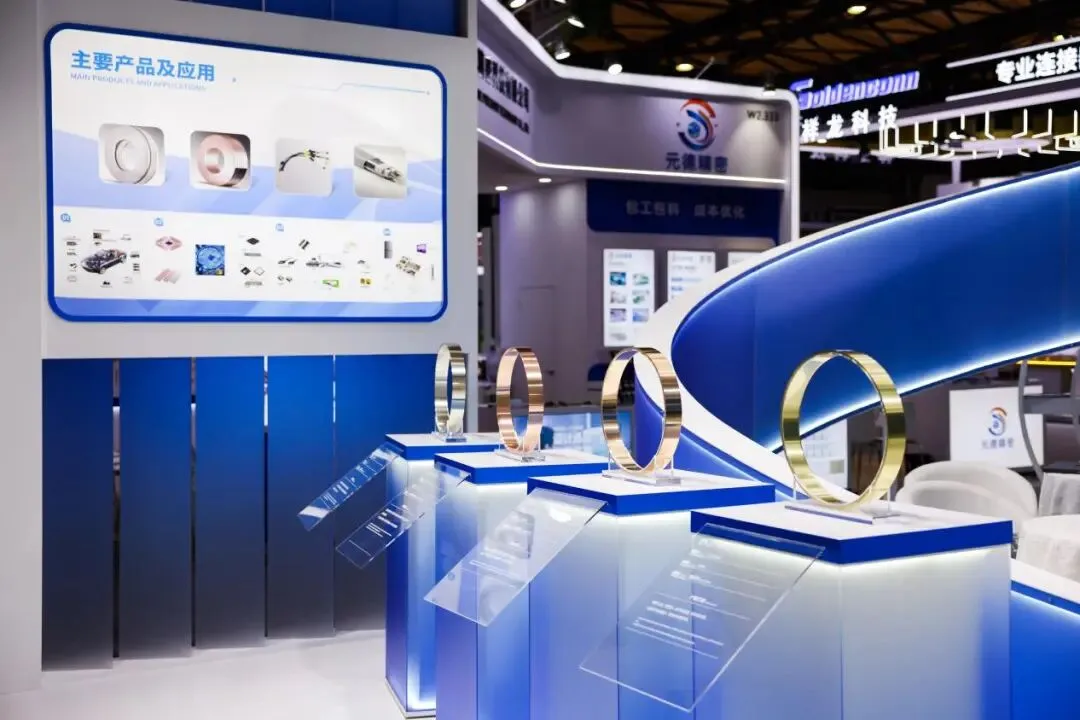
“The products we are showcasing this time fall into two main categories: the first is our new type of tinned copper strip, which is also our single-item champion product, including reflow tinning, hot-dip tinning, and three-layer electroplated products; the second category consists of high-performance product series developed in the past three years, including high-strength, high-conductivity copper-nickel-silicon alloys, copper-chromium-zirconium alloys, and high-speed communication copper cables,” Wang Sheng introduced.
To meet the “high-temperature challenge” of 800V high-voltage platforms, Xinke has introduced third- and fourth-generation copper alloys such as C7025 and C18150. Utilizing nanoscale precipitation strengthening technology, these materials significantly enhance high-temperature stress relaxation resistance while maintaining excellent electrical conductivity, enabling stable operation under harsh conditions ranging from 150°C to 200°C. Wang Sheng stated directly: “The core pain points for downstream connector manufacturers have evolved from simply ‘checking material grades’ to demanding ‘system-level solutions.’ What we offer is not just a single material, but a proven material selection solution.”
In the high-speed transmission sector for AI, Xinke’s moves demonstrate forward-thinking vision – currently developing the XKC70385 with independent intellectual property rights. “Besides high strength and high electrical conductivity, it also excels in thermal conductivity, making it a core material for AI computing centers and high-speed communications.” Additionally, C5210 has already been mass-produced for AI high-speed connectors, while C7025 has entered the market for high-speed backplane connectors.
03
Supply Chain Moat
Five Major Bases Form a “Proximity Service Network”
If technological breakthroughs are the sharp edge, then this cross-continental industrial landscape is Xinke’s deeply cultivated “moat.”
To date, Xinke has established a matrix of five manufacturing bases centered in Wuhu, extending to Wuxi, Guangxi, Jiangxi, and Sichuan, achieving deep coverage across the Yangtze River Delta, Pearl River Delta, and Chengdu-Chongqing economic zones. Unlike traditional scale expansion, Xinke has adopted a highly flexible “one location, one strategy” differentiated approach:
Wuhu, serving as the main base, focuses on high-performance, difficult-to-manufacture alloys such as copper-nickel-silicon and copper-chromium-zirconium, tackling the most challenging technical hurdles. Wuxi, leveraging its mature supporting infrastructure, specializes in precision processing of ultra-thin strip materials. Guangxi, benefiting from its geographical advantages, takes on high-end tin-phosphorus bronze and deepens its presence in Southeast Asia and South China markets. Jiangxi is positioning itself in zinc-copper alloy and high-end copper-nickel-tin products to fill the gap in the central region for premium materials. Meanwhile, Mianyang in Sichuan targets the AI computing power trend, focusing specifically on high-speed communication copper cables.
This refined regional division not only enables each factory to serve key customers locally, significantly reducing logistics and delivery costs, but also establishes an efficient supply chain network with a “30-minute response circle.”
On the manufacturing side, Xinke is also building foundational barriers. The company has established a national-level technology center and a CNAS-certified laboratory, and introduced key equipment such as advanced vertical high-temperature solution continuous annealing furnaces, enabling precise control over nano-scale precipitated phases in copper alloys and significantly enhancing material strength. Wang Sheng stated that Xinke is not merely a supplier but also a “R&D partner” for its customers. Xinke’s laboratory helps downstream clients rapidly iterate through material selection in the early stages, even enabling mass production without physical samples in simple applications, greatly shortening the time-to-market for customer products.
04
Competitiveness in the Details
Tin-plated Material Upgrade and Green Brand
After its tinned copper foil was recognized as a “Manufacturing Single Champion Product” by the Ministry of Industry and Information Technology, Xinke did not stop there.
Wang explained that the upgrade efforts mainly focus on two directions: upgrading hot-dip tin materials and developing low-insertion-force multilayer reflow electroplated tin – latter of which uses copper as a substrate with nickel plating. The Ni layer suppresses the diffusion of base material elements to the surface, thereby controlling the residual metal layer at the topmost surface and reducing insertion force. “This technology effectively meets the insertion force requirements for automotive multi-pin connectors and represents the latest domestic technology available.”
On the other hand, as international automakers incorporate ESG and carbon footprint into hard supply chain metrics, Xinke – designated a national green factory – is leveraging digital intelligence to implement carbon labeling. This “green passport” will significantly facilitate downstream connector manufacturers’ overseas expansion, enabling them to seamlessly integrate into high-end global supply chains.
Conclusion
Xinke Materials’ journey is precisely a microcosm of China’s connector industry chain breaking through from the materials end upward.
From a long-time follower blocked by overseas giants, to today’s trailblazer daring to set standards in the new AI frontier; from focusing on niche champions to secure its core business, to entering the new AI computing arena through high-speed communication copper cables.
Xinke has proven that breakthroughs in China’s high-end manufacturing depend not only on emerging “little giants,” but also on seasoned veterans who are willing to take one more step forward on the copper belt they’ve been working on for thirty years.