
At the beginning of 2026, a price adjustment storm initiated by global connector giants swept through the entire industrial chain. From TE Connectivity, Amphenol to Hirose Electric, Molex, and JAE, major manufacturers successively issued price increase notices, with the increase ranging generally from 3% to 15%. Even domestic leading manufacturers such as Luxshare Precision Industry and AVIC Optoelectronics simultaneously launched differentiated price adjustment actions.
However, behind this chorus of “gains”, the industry presents a highly polarized picture.
This is not merely a simple cost fluctuation; it is a reshuffling concerning technological discourse power, supply chain resilience and survival hierarchy.
01
The “Confidence” of the Giants
Raising prices is not a passive defense but an active reshuffle.
In this round of price hikes, the world’s leading connector enterprises have demonstrated extremely strong initiative and control, with their price increase actions being decisive and orderly.
Starting from January 5, 2026, TE Connectivity (TE) will officially implement a price increase across all product lines and regions, with the increase range set at 5% to 12%. Amphenol, on the other hand, took the lead by initiating the first price adjustment on New Year’s Day, covering all categories including communication and automotive, leaving little buffer room for the market.
HRS plans to raise prices by 4% to 15% in the second quarter of fiscal year 2026, with a focus on high-value products such as micro and board-to-board components.
Molex will implement a price adjustment from single to double digits starting from January 2026, focusing on industrial and legacy products; JAE, on the other hand, adopts a dynamic pricing strategy that is linked to LME metal prices.
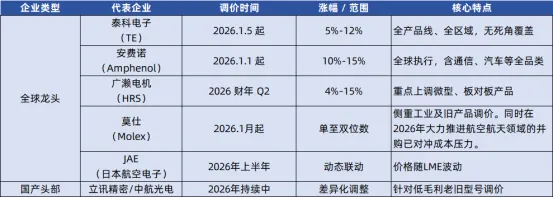
Domestic companies like Luxshare Precision Industry and AVIC Optoelectronics have also simultaneously initiated differentiated price adjustments for low-margin, outdated models.
The logic behind the price hikes by the industry giants is clear and multi-faceted, and by no means simply driven by cost pressures:
Cost pressure transmission: The prices of core raw materials such as copper, plastic resins and electroplating have been rising continuously, coupled with the increase in labor and logistics costs, the profit margins of enterprises have been continuously squeezed. Raising prices is a direct means to offset costs.
The direct manifestation of bargaining power: Leading manufacturers, relying on their monopolistic position in the high-end market, have a stronger ability to pass on costs and do not have to passively bear pressure. Downstream customers have a higher acceptance of their price changes.
Proactively optimizing product structure: Many giants take the opportunity of price hikes to accelerate the elimination of old production lines with low gross profit margins, and shift resources towards high-end products with high added value, achieving an iterative upgrade of business structure.
The “rigid purchase” of customers: For some customers, although connectors are small, they directly affect the stability of the entire machine. The risk of changing suppliers is much greater than accepting price increases. Therefore, core customers are generally willing to pay a premium for leading brands.
Yang Xuying, the executive director of Dongguan Ruisong Electronic Technology Co., Ltd., said that major players in the industry have more complete risk hedging systems and stronger cost-passing capabilities. Even in the face of cost anxiety, they can smooth out the impact of fluctuations through long-term agreement mechanisms and price linkage formulas, thus maintaining profits and stabilizing core cooperative relationships.
02
Domestic substitution
Is it a “passing opportunity” or a “logical trap”?
Every time international giants trigger a wave of price hikes, the industry is always filled with optimistic voices claiming that “the spring of domestic substitution has arrived.” However, in this round of price hikes in 2026, such blind optimism was completely doused with cold water, and the realistic predicament of domestic substitution was further magnified.
A business executive of a connector company spoke frankly: “Don’t be misled by the slogan of domestic substitution. The differentiation of the high-end industrial chain has long been established and is unlikely to be reversed in the short term.” His viewpoint reveals the true situation of domestic substitution at present.
The threshold of the system is hard to overcome: To enter the supply chain of the top ten global automakers and leading communication equipment manufacturers, it is never about price discounts, but rather years of reliability verification, strict quality control, and complex system certification. Downstream customers will never risk the malfunction of the entire machine and damage to their reputation by replacing an unverified domestic component just because a giant raises its price by 5%.
Technical deficiencies remain a major drawback: True domestic substitution has long transcended the initial stage of “price substitution” and entered a core competition period of “technical positioning”. In the high-end market, the price base of foreign connector brands is already high. Even if they raise prices, customers in core fields value technical stability, compatibility and service capabilities more. Domestic manufacturers are unlikely to break through the technical authority barrier in the short term.
The cost advantage is continuously eroding: The core logic of domestic substitution in the past was the “cost advantage” formed by relying on the local manufacturing chain. However, when core raw materials such as copper and gold experience a global price surge, this advantage will be rapidly diluted. If the core components of domestic connectors (such as precision molds and special materials) still rely on imports, the price increase will further squeeze the profit margin and weaken their limited competitiveness.
03
Who is eating the meat and who is having the soup?
If this round of price hikes is a major test of the industry’s overall strength, then the core of the test paper is only one: the comprehensive competitiveness of enterprises. Under the storm, who can get the meat and who can get the soup?
Li Yiping from the Shenzhen Connector Industry Association pointed out that these three types of enterprises might benefit from this round of price hikes:
“Premium Pricers” Driven by R&D: The wave of price hikes may actually be beneficial for enterprises with strong R&D capabilities. Newly developed high-end products can be initially priced based on the current high costs, locking in higher gross profit margins. Once raw material prices fall in the future, the profit margins of such products will further expand, creating a virtuous cycle of “trading technology for space” and enabling them to take the initiative in industry fluctuations.
The cross-border players of “integration” transformation: Taking Luxshare Precision as an example, the proportion of pure connectors in its business structure is continuously shrinking, and it is being replaced by the “system integration” model – such as the integration of internal components of Apple products and the integration of entire car control boards. These enterprises take connectors as part of the system solution, possess extremely strong solution capabilities and customer stickiness, and the pressure of raw material fluctuations can be effectively diluted in the complex system premium, significantly enhancing their risk resistance.
“Hidden Champions” Deeply Cultivating High-Profit Niches: Instead of pursuing a full product range, they focus on specific high-barrier niches such as automotive connectors, accumulating rich technical experience and customer resources. Through project-based cooperation deeply bound with downstream customers, they avoid low-end price wars by offering rapid response and stable quality, maintaining steady growth during industry cycle fluctuations and becoming a “safe haven” during price hikes.
04
Not only the price, but also a dividing line.
The price surge of connectors in 2026, which seems to be a short-term market response triggered by fluctuations in raw material prices, is actually a “watershed” for the industry’s transformation towards high-end, intensive and industrial integration. It marks a fundamental change in the competitive logic of the connector industry.
For domestic connector manufacturers, the era of relying solely on “price wars” to capture the market has come to a complete end.
The key to success or failure in future industries does not lie in how much the copper price has risen or how much costs have been reduced, but in whether one can break through core technological bottlenecks, form a scale production advantage, and transform from a “product supplier” to a “solution service provider”.
This industry-wide “upward trend” is not only a warning to enterprises’ cost control capabilities, but also an ultimate test of the industry’s overall strength.
When the tide recedes, it will be clear who was swimming naked and who can achieve iterative evolution in the storm. The outcome of this industry reshuffle will ultimately reveal the answer.