

According to the official announcement from TE Connectivity (referred to as “TE”), its annual Investor Day will be officially held on November 20th.
As a leading enterprise in the global connector field, TE’s strategic moves have always been a barometer for the industry landscape – whether it is technological product iteration, industrial layout or capital operation, it may trigger a chain reaction in the connector market.
At this juncture, “International Cables & Connectors” reviews and looks ahead at TE’s core actions in 2025, dissecting the growth logic and future direction of this global interconnection giant from new product layout, mergers and acquisitions integration to financial performance.
New Product Focus: “High-Speed Interconnection Engine” in the Era of AI
As the power consumption of AI servers continues to rise, liquid cooling solutions are becoming increasingly mainstream within data centers. In its announcement for the OCP Global Summit, TE stated that the company will showcase liquid-cooled I/O and thermal management interconnection solutions at the exhibition, emphasizing its focus on thermal management and connector performance for compact and high-density systems.
In terms of high-speed interconnection, TE released its UltraLow-Profile PCIe Gen7 series connectors/cable assemblies in August 2025, supporting up to 128 GT/s, which is suitable for AI and data center systems.
Furthermore, at the OFC2025 exhibition, TE demonstrated its “hybrid heat bridge + liquid cold plate structure” technology demonstration, indicating that it is indeed exploring thermal management solutions for high-performance I/O in liquid cooling systems.
The above actions clearly demonstrate that TE is committed to providing an integrated solution of “connection + thermal management” to directly address the extreme challenges faced by AI servers in terms of speed, power consumption and heat dissipation.
Mergers and Acquisitions Integration: From Industrial Interconnection to Energy Interconnection
Mergers and acquisitions have always been an important means for TE to drive its strategic transformation. Following the acquisitions of automotive electronics and industrial automation, TE has made another move in the energy infrastructure sector this year.
In April this year, TE completed the acquisition of Richards Manufacturing. Richards is an electrical and gas distribution product supplier headquartered in New Jersey, USA. It has strong competitiveness in the fields of medium-voltage cold shrink cable accessories, network protectors, and underground distribution equipment.
TE’s CEO Terrence Curtin stated that this acquisition will enable the company to “seize the opportunities presented by the North American power grid upgrade cycle and expand its product portfolio in the power utilities and energy transition markets.”
In the context of the global energy structure accelerating its transition towards distributed and renewable forms, the security, stability and intelligence requirements of grid interconnection have significantly increased. This aligns naturally with the industrial interconnection technology of TE.
Industry analysts believe that this transaction is not only TE’s “market expansion”, but also an extension of its industrial role – from an industrial interconnection company mainly focusing on manufacturing, automobiles and communications in the past, it has gradually transformed into an “energy system interconnection supplier”.
This means that the future growth points of TE will be more derived from energy infrastructure, electric transportation and energy storage networks, rather than merely the traditional fields of industrial automation and communication equipment.
Financial and Capital Signals: Stable Cash Flow and Expansion Resilience
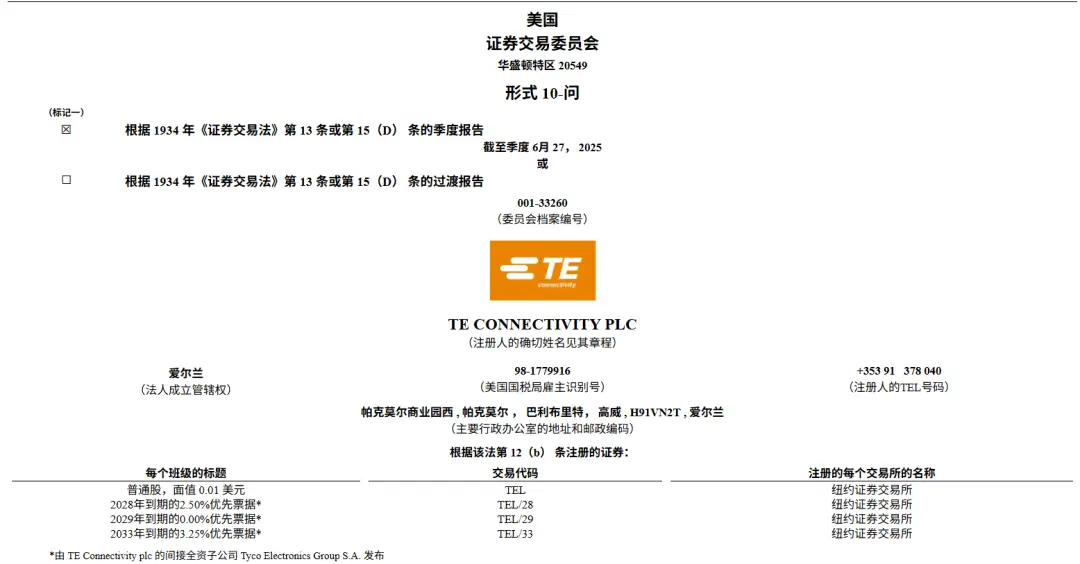
From the financial data, TE continues to maintain a steady growth pace. According to its third-quarter financial report for the fiscal year 2025, TE’s sales increased by approximately 14% year-on-year, and its net profit margin remained around 18%. Among them, the industrial solutions segment continued to contribute the largest share, while the communication and sensing business performed particularly well due to the rapid growth of AI servers and smart electric vehicles.
What is more worthy of attention is TE’s capital actions:
On April 29 this year, TE issued senior notes worth a total of 900 million US dollars through its subsidiary Tyco Electronics Group S.A. The issuance structure was divided into two parts (each 450 million US dollars), with maturities set for 2031 and 2035 respectively. The company clearly stated that the net proceeds from the bond issuance would be used for general corporate purposes, including repaying debts related to the acquisition of the Richards Manufacturing business. It will also support future mergers and capacity expansion simultaneously. In TE’s second-quarter report for 2025, the company raised the quarterly cash dividend per ordinary share by 9% from 0.65 US dollars to 0.71 US dollars. This dividend was paid to shareholders registered as of the close of trading on May 21 this year.
In the current situation where global manufacturing capital is tight and financing costs are high, these decisions can be interpreted as signals of confidence – TE not only “can hold steady”, but also “has the capacity to increase further”.
In recent years, TE has continuously enhanced its operational efficiency through mergers and acquisitions, automation of production lines, and digital transformation. This has ensured a strong free cash flow. Industry experts believe that this has provided sufficient “ammunition” for its global expansion over the next three to five years.
It is worth noting that TE’s investment focus has also undergone a subtle shift: in the past, its capital was mainly allocated to automotive electronics and industrial automation, but now it is more invested in AI infrastructure, energy interconnection, and high-voltage high-power connection technologies, reflecting its keen perception of long-term trends.

Outlook: The Next Move for TE
As the investor day on November 20 approaches, “International Cables & Connectors” speculates that the market may focus on TE’s latest statements in the following three major areas:
Core technology roadmap: Will the company disclose the product planning for the next-generation high-speed interconnection or high-voltage connection technologies?
Capacity and supply chain strategy: How will they cope with the sudden increase in demand for AI servers, fluctuations in raw materials, and the rebalancing of regional production capacity?
Energy and industrial layout: Are there any further mergers and acquisitions or investments to deepen their presence in the fields of power grids, energy storage, and new energy vehicles?
Regardless of the outcome, TE has already established itself as one of the most reliable “long-term players” in the connector industry, thanks to its solid financial foundation, advanced technological reserves, and astute strategic vision.
In an era where AI, electrification and energy interconnection are intertwined, every move made by TE is like charting the path for the future of the entire industry.
From “faster signals” to “more stable currents”, from “single-point connection” to “system interconnection”, TE is once again making “connection”, a seemingly basic matter, the focus of the industry.