
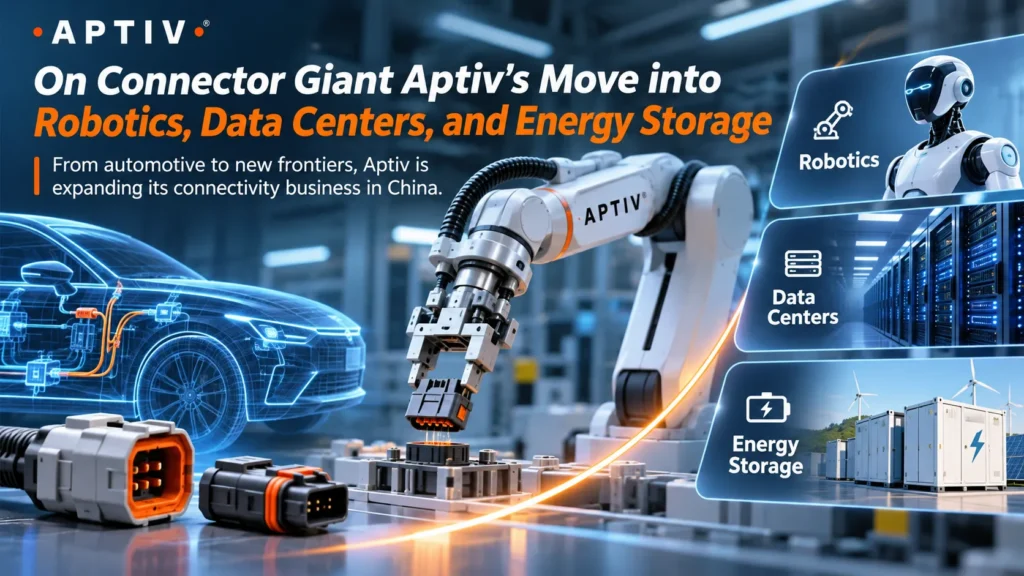
While partnering with a leading domestic memory chipmaker to strengthen its local automotive electronics supply chain, Aptiv has also launched a new connector project in Shanghai, bringing robots into production workshops. Since November, Aptiv has made a series of moves in the Chinese market, extending its focus from automotive to robotics, data centers and energy storage.
From the order perspective, the transformation is already becoming apparent: in the third quarter of 2026, Aptiv’s new business orders in the Chinese market grew 30% year on year, with more than 20% related to export projects; in the first three quarters, new orders for non-automotive businesses reached about $3.8 billion, more than doubling year on year.
As the overall growth of the automotive industry slows, what new growth engines is this veteran connector giant seeking as it steps beyond its traditional comfort zone?
01
Connector Giant
Joins Hands with a 10-Billion-Yuan Memory Chip Leader
One is a global leader in automotive technology and connectivity systems; the other is a leading domestic memory and MCU chipmaker with revenue exceeding 20 billion yuan in the first three quarters. Aptiv and GigaDevice’s cross-industry partnership has landed in the automotive electronics supply chain.
According to the strategic cooperation details announced by the two companies, the partnership goes beyond the introduction and validation of chip products, extending to supply chain collaboration and industrial ecosystem development:
· Core introduction areas: Focusing on three core domains – smart cockpit, intelligent driving and body control – the companies will prioritize the introduction and validation of automotive-grade memory and other products, and promote the mass production of related products in future vehicle models.
· Joint development of the underlying ecosystem: The two sides will also collaborate on automotive chip testing and validation, the development of corporate standards systems, the sharing of industrial chain resources and technical cooperation.
As automotive electronic and electrical architectures evolve toward “centralized computing+regional control,” the coupling between hardware systems and underlying chips has reached an unprecedented level. At the same time, semiconductor cost volatility has become a key issue in supply chain management.
GigaDevice’s 2026 semi-annual report cited Omdia data, stating that in 2025 its global market share in SPI NOR Flash was about 19.4%, ranking second worldwide. In the first three quarters of 2026, the company achieved revenue of 20.297 billion yuan, up 197.11% year on year. The company explained that during the reporting period, supply in the memory chip industry was tight, and both volume and prices of memory products rose.
Aptiv also mentioned rising semiconductor costs at its third-quarter earnings call, saying the related pressure mainly came from memory chips.
Yang Xiaoming, President of Aptiv China and Asia Pacific, said the move is a key step in advancing the “In China, for China, for the world” strategy. By deepening cooperation with leading local chip design companies, Aptiv can not only strengthen the delivery resilience and cost advantages of its local supply chain, but also provide more options for serving Chinese automakers’ overseas projects.
02
New Connector Project Launched
Targeting Three New Blue Oceans
While consolidating its automotive electronics base, Aptiv’s connector business is accelerating its spillover into non-automotive industrial fields. According to a report by Shanghai Observer, Aptiv’s new connector system project has been launched in Anting Town, Jiading District, Shanghai. The project leverages Aptiv’s existing smart manufacturing plant and focuses on embodied intelligent robots, data center servers and battery energy storage systems.
These three directions share one commonality: they all require stable and efficient power or signal connections. Different scenarios require connectors to solve different problems. For Aptiv, the connection technologies, precision manufacturing and reliability validation experience accumulated in the automotive sector provide a foundation for expanding into new applications. Aptiv Central Electrical (Shanghai) Co., Ltd. has been rooted in Jiading for many years. It serves as the Asia-Pacific headquarters and R&D center for Aptiv’s connector business and is also one of the company’s important global connector production bases. Although public reports have not yet disclosed the project’s specific investment amount, production capacity scale or timeline to full capacity, the strategic direction is already very clear: this complements the automotive-grade chip cooperation between Aptiv and GigaDevice, forming two complementary paths. One line of business is deeply exploring the automotive electronics supply chain, while the other extends the precision manufacturing and reliability validation capabilities accumulated in the automotive connector field to the robotics, data center, and energy storage markets.
03
Robotics Enters the Connector Workshop
Ampere Adds Another Role
At the Ampere booth at the China International Import Expo, which opened on November 5, a robot from Tashi Zhizhang demonstrated on site the full process of autonomous connector material picking, precision mating and assembly, and material feeding. This was more than a booth demonstration; it also reflected Ampere’s new role in the robotics industry chain.
According to disclosures by Ampere, robots from its partners (Tashi Zhizhang and Shanghai Electric) are being gradually deployed on its production lines; meanwhile, Ampere’s high-performance computing platforms and intelligent power distribution solutions will also be integrated into its partners’ robot products.
This means that in the robotics industry chain, Ampere plays two roles at once: both a user of robots and a supplier of robot-related technologies and products.
For Ampere, its own factories can provide real assembly and manufacturing scenarios for robots; supplying computing, power distribution, and related technologies to robotics companies gives it the opportunity to participate in a new industry chain.
But completing connector assembly on the booth is still several hurdles away from long-term, stable operation on production lines: when faced with connectors of different specifications, can the robot switch quickly? Can the success rate of precision mating and the production cycle time meet requirements? What are the costs of maintenance, commissioning, and manual takeover?
The answers to these questions will determine whether robots can move from demonstration applications to larger-scale deployment, and whether the relevant partnerships can translate into tangible commercial returns.
04
China Orders Up 30%
How Many Opportunities Remain Beyond Automotive?
Ampere’s recent flurry of activity is already evident in its third-quarter 2026 financial results and order data:
· Modest earnings growth: In Q3, the company reported revenue of $3.199 billion, up about 2% year over year, and net income from continuing operations of $194 million. Among these, the engineering components business, which covers connectivity-related products, saw adjusted revenue grow 6% year over year.
· Accelerating orders for China export projects: In the first three quarters, Ampere’s global new business orders exceeded $13 billion, with China market orders up 30%, and more than 20% of China’s new orders related to export projects. The company also won a nomination for integrated cockpit controllers for Chinese automakers’ European and global export projects.
· Non-automotive business growing faster: In Q3, within the engineering components segment, adjusted revenue for the automotive business grew 2%, while adjusted revenue for the non-automotive business surged 16%. In the first three quarters, new orders for the non-automotive business reached about $3.8 billion, doubling year over year, and the company secured high-performance interconnect projects for AI data centers, energy storage, and other fields.
Meanwhile, at this year’s China International Import Expo, Ampere showcased automotive-grade fiber-optic interconnect systems, optical communication domain controllers, and related technologies for data centers and energy storage. From automotive to robotics, from in-vehicle data transmission to data center interconnects, Ampere is expanding the boundaries of connectivity applications.
Conclusion
Whether it is the partnership with GigaDevice on automotive-grade chips, the launch of a new connector project in Shanghai’s Anting, or the intensive deployment of 100 robots on its production lines, all of these ultimately must be tested by commercial returns. When the new projects will contribute actual revenue, whether robots can make the efficiency and cost equation work in precision assembly, and how many non-automotive new orders can be converted into revenue on schedule will be the key to determining whether Aptiv can successfully navigate the automotive cycle and establish a foothold in the blue ocean of non-automotive markets.